 Skip to content
Two houses on the same street. Same size, same family size, same city. One gets a bill of eight thousand rupees, the other gets nineteen thousand.
The difference usually isn't luck and it isn't a faulty meter. It's the slab system — and a handful of habits that quietly push a household from one side of a tariff boundary to the other.
This one's worth understanding properly, because it's the only part of your bill you actually control.
"Unit" Ka Matlab Kya Hai?
One unit = one kilowatt-hour (kWh).
That means running a 1,000-watt appliance for one hour. Or a 100-watt appliance for ten hours. Or ten 100-watt bulbs for one hour. Same thing.
Your meter counts these. Your bill's "units consumed" figure is just present reading minus previous reading. Everything else on the bill is arithmetic performed on that one number.
Pakistan Ka Slab System — Ye Sabse Ahem Cheez Hai
Here's where most people's mental model of their bill is wrong.
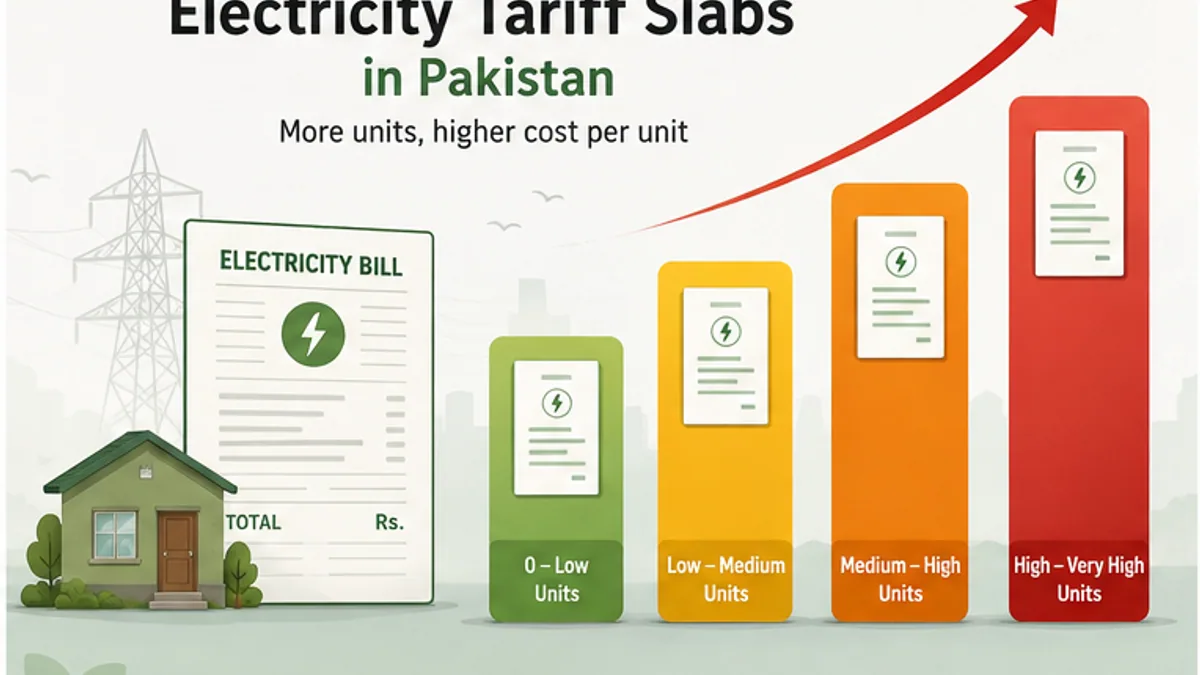
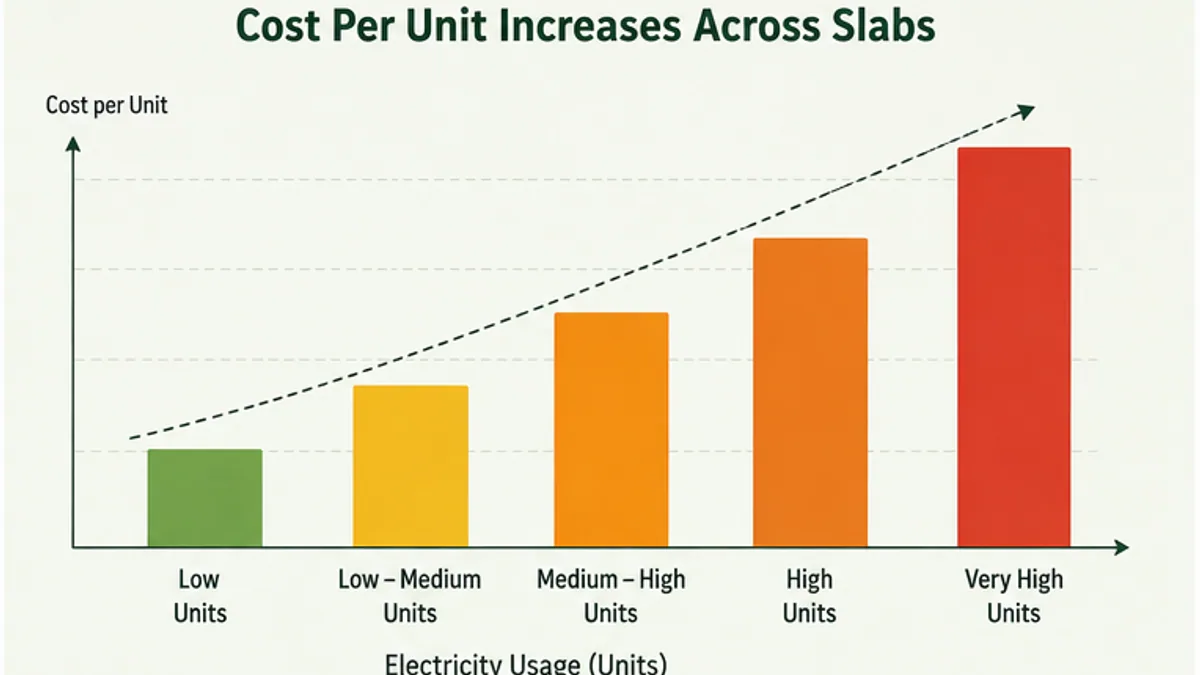
Pakistan does not charge a flat rate per unit. Domestic tariffs are slab-based, and the rate climbs as your monthly consumption climbs. The bands are broadly structured around thresholds like 100, 200, 300, 400, 500, 600 and 700 units, with rates stepping up at each level.
On top of that there's a split between protected and unprotected consumers. Protected status is for low-consumption households that stay under a threshold consistently over a period of months — and it carries meaningfully cheaper rates. Cross the line and stay across it, and you lose protected status, which is a much bigger jump than the extra units alone would suggest.
This is why bills don't scale smoothly. Going from 180 units to 220 units doesn't raise your bill by 22%. It can raise it far more.
One practical consequence worth internalising: if your household typically sits close to a slab boundary, saving twenty or thirty units is worth disproportionately more than the same saving would be if you were already deep inside a high slab. Knowing which side of a line you're on is genuinely valuable information, and the only way to know is to look at your units every month.
Aik Zaroori Baat: Rates Change Hote Rehte Hain
I'm deliberately not printing a table of exact rupee-per-unit figures here, and I'd be sceptical of any page that does without a date on it.
Pakistani electricity tariffs are notified by NEPRA, and they get revised — sometimes annually, sometimes more often. On top of the base tariff sit adjustments that move every single month. A rate table published eight months ago is actively misleading today.
For the current notified rates, the reliable sources are NEPRA's own tariff notifications and your distribution company's tariff page. For Karachi, note that K-Electric operates on its own separately notified tariff, so 1 unit price in Karachi and K-Electric per unit price are genuinely different questions from the rest of the country.
What doesn't change is the structure, and that's what's actually useful to understand.
Bill Mein Sirf Units Ka Kharcha Nahi Hota
If you multiply your units by the slab rate and compare with your bill total, the numbers won't match. That's normal. Here's what sits on top:
Fuel Price Adjustment (FPA). Changes monthly, applied nationally, based on what it actually cost to generate electricity in a given period. This is the single biggest reason two months with identical usage produce different bills. Nobody at your DISCO decides it.
Quarterly Tariff Adjustment (QTA). Periodic adjustments applied across a quarter.
Electricity Duty. A provincial levy, calculated as a percentage.
GST. Applied on the assessed amount.
TV Licence Fee. A fixed monthly amount on domestic connections.
Meter rent and, depending on your connection type, a fixed charge.
And if you're late, a late payment surcharge — which is exactly the gap between the two payable amounts printed on your bill.
None of these are hidden. They're all itemised. But they explain why "units × rate" never equals the total, and why a bill calculator can only ever give you a ballpark.
Bill Calculator Kitna Bharosemand Hai?
People search for a LESCO bill calculator or a general electricity bill calculator for two reasons: to sanity-check a bill that arrived, or to predict one that hasn't.
Both are reasonable uses. Just know the limits.
What a calculator does well: takes your units, applies slab rates, and gives you an approximate energy charge. If your bill's energy charge is wildly different from that estimate, something's worth investigating.
What no calculator can do: predict your exact total, because FPA for the current month isn't announced in advance. Anyone claiming otherwise is guessing.
So treat calculator output as a range, not a figure. It's a smoke detector, not an invoice.
Kaunsa Appliance Kitni Bijli Khaata Hai
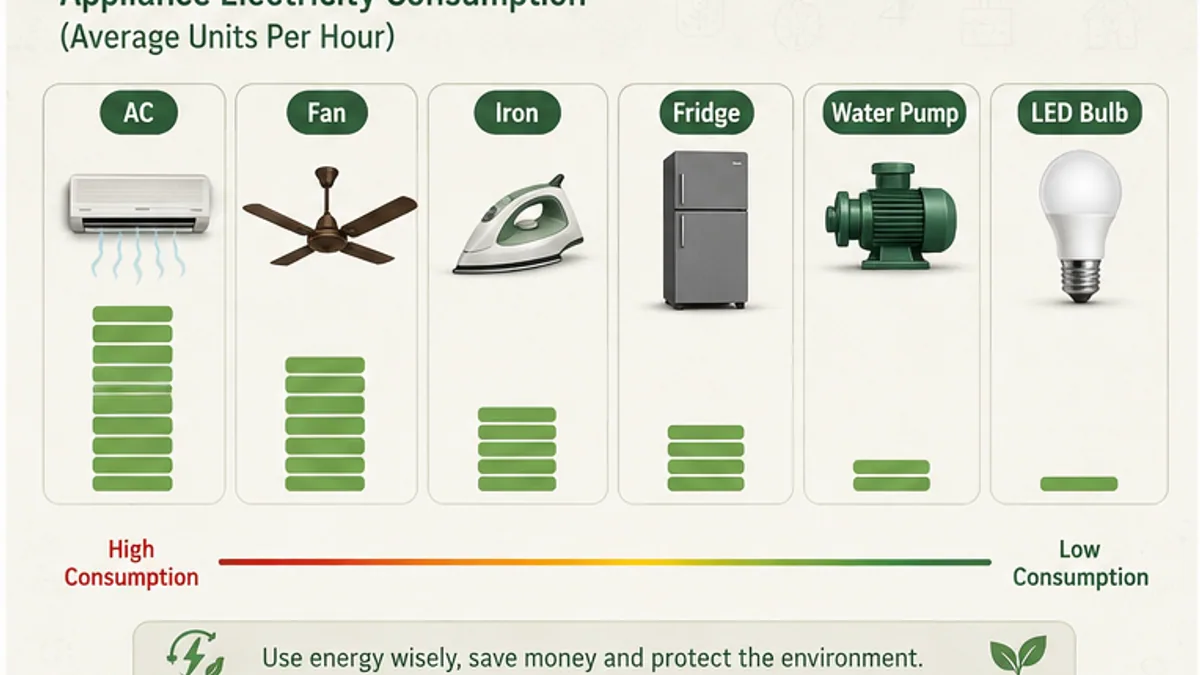
This is the part that actually changes behaviour, because most people have no idea how lopsided the distribution is.
Rough figures, and they vary by model, age and how well the thing is maintained:
| Appliance | Approximate consumption |
|---|---|
| 1.5 ton inverter AC | roughly 0.9–1.5 units per hour once the room is cool; higher during initial cooling |
| 1.5 ton non-inverter AC | roughly 1.5–1.8 units per hour, running near-constantly |
| 1 ton AC | roughly 0.7–1.2 units per hour |
| Electric water geyser | 1.5–2 units per hour of heating |
| Iron | 1–1.5 units per hour of use |
| Refrigerator (medium) | around 1.5–3 units per day total |
| Washing machine | around 0.5 units per wash cycle |
| Water pump (0.5–1 HP) | around 0.4–0.75 units per hour |
| Ceiling fan (standard) | around 0.07 units per hour |
| Ceiling fan (DC inverter) | around 0.03 units per hour |
| LED bulb | around 0.01 units per hour |
| LED TV | around 0.05–0.1 units per hour |
Read that table again and notice the scale. One 1.5 ton AC running eight hours is roughly equivalent to running twenty ceiling fans for the same eight hours.
Which means all the effort people put into switching off bulbs — genuinely worth doing, but it's not where your bill lives. Your bill lives in the AC, the geyser, and the iron.
1.5 Ton Inverter AC: Kya Waqai Bachat Hoti Hai?
Short answer: yes, but not the way the marketing implies.
A non-inverter AC's compressor is either fully on or fully off. It blasts to the set temperature, shuts down, warms up, blasts again. Every restart draws heavily.
An inverter compressor varies its speed. It works hard to reach temperature and then throttles down to a low, steady output to hold it. The savings come from that holding period — which means the longer you run it continuously, the more the inverter saves you.
Running an inverter AC for forty minutes and switching it off captures almost none of the benefit. Running it for six hours captures most of it.
Two things that matter more than most people expect: thermostat setting and servicing. Every degree lower on the thermostat costs you noticeably. And a dirty filter or low gas makes the compressor run longer to achieve the same cooling — which quietly erases the inverter advantage entirely.
Bill Kam Karne Ke Practical Tarike
Not lecture material. Things that measurably move the number.
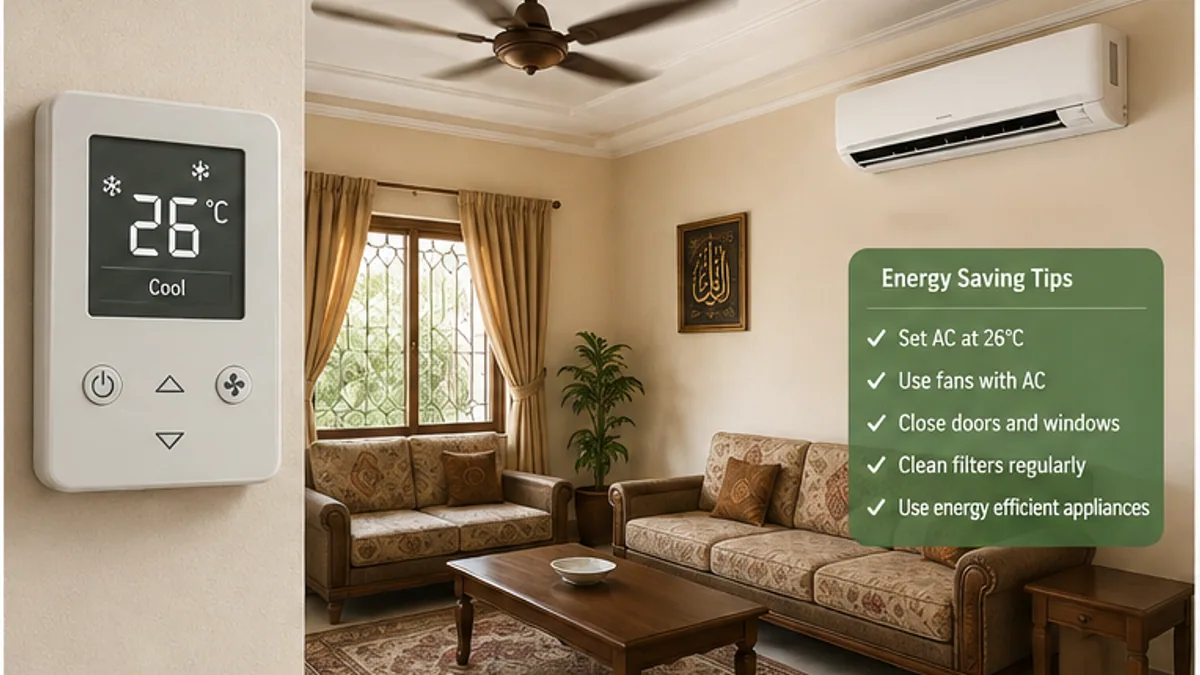
Thermostat 26 ke aas paas rakhein. Combine it with a fan and the room feels the same as a colder setting at a fraction of the cost. This is the highest-value single change most households can make.
AC ki service karwaein. A clean filter and correct gas pressure. A neglected unit can consume substantially more for identical cooling.
Geyser ka timer. Electric water heaters are the second-biggest silent consumer in most homes. Heating water for twenty-four hours so it's ready for two showers is expensive. If it's on a switch, use the switch.
Istri ek saath karein. An iron draws heavily and most of the energy goes into the initial heat-up. Doing a week's clothes in one session beats seven separate heat-ups.
DC inverter fans. Roughly half the consumption of a standard ceiling fan, and in a house with six or seven fans running through a long summer, that adds up to a real number.
LED sab jagah. Small individually. Not small across twenty fittings over a year.
Standby ko seriously lein. TVs, decoders, chargers, microwaves with displays. Individually trivial, collectively a steady drip that never stops.
Har mahine units check karein. This is the one most people skip, and it's the one that catches everything else. Two minutes on the bill portal tells you your usage trend, flags an estimated reading before it compounds, and tells you exactly how close to a slab boundary you're sitting.
Sab Se Zaroori Baat
You can't control NEPRA's tariff. You can't control FPA. You can't control GST.
What you can control is which side of a slab boundary your household lands on — and for a lot of Pakistani homes sitting near a threshold, that single fact is worth more than every other saving tip combined.
Check your units. Know your number. The rest follows.
Related reads on BijliBills: WAPDA bill check online, LESCO bill check, MEPCO bill check, IESCO bill check