 Skip to content
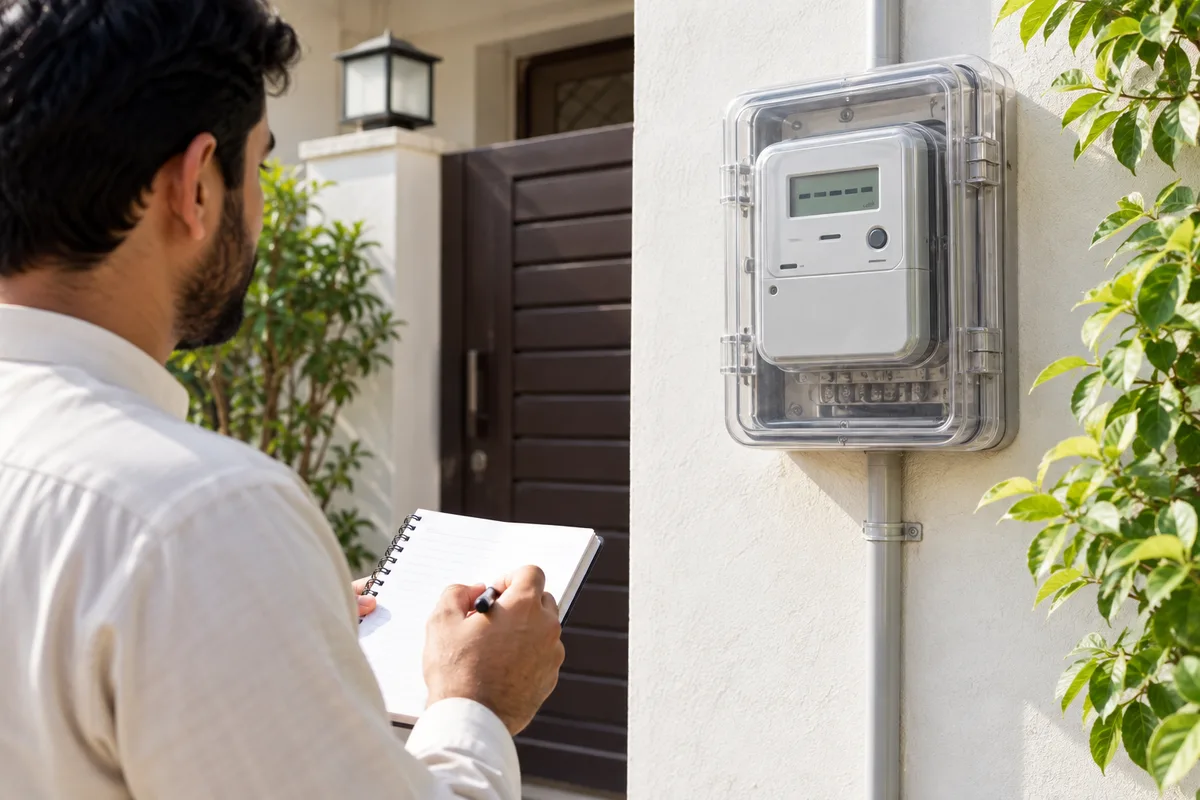
After an electricity meter is replaced, keep the replacement date, both meter numbers, the old meter’s closing reading if available, and the new meter’s opening reading. The next bill may involve more than one reading period. A new display starting near zero does not erase electricity already consumed through the old meter.
If a meter is burnt, damaged, sparking, or unsafe, stay away and report it through the supplier’s emergency channel. Recording information never justifies approaching dangerous equipment.

Make a replacement record
| Detail | Why to keep it |
|---|---|
| Replacement date | Separates the old and new metering periods |
| Old meter number | Identifies the removed device |
| Old closing reading, where available | Supports the old-period consumption check |
| New meter number | Confirms the replacement belongs to your account |
| New opening reading | Provides the starting point for the new period |
| Work order or complaint reference | Connects the event to the supplier’s records |
Ask the authorized team or office for the relevant record. Take photographs only where safe and permitted. Never break a seal, remove a cover, or attempt a replacement yourself.
Compare two separate intervals
Here is a simplified example using a multiplying factor of one and no estimated readings. The old meter’s previous reading was 10,200 and its closing reading was 10,260, giving 60 units. The new meter opened at 5 and later read 85, giving 80 units. The combined measured consumption across those intervals would be 140 units.
The new meter’s reading of 85 alone would not describe the entire period. Equally, adding both cumulative readings together would be incorrect.
If a multiplying factor, separate TOU registers, estimated billing, or another adjustment applies, ask for the full calculation rather than forcing the bill into this simple example.
When the old meter could not be read
Defective-meter and washed-display cases have specific assessment and adjustment procedures. MEPCO’s revised 2025 Consumer Service Manual, section 4.3, addresses meter replacement and bill adjustment. Ask the supplier which clause and evidence it used in your case, including any average billing or later data retrieval.
Do not assume every extra unit is an error, or that a damaged display permits any amount to be charged without explanation. The calculation, period, and supporting record are the useful points to request.
Check the first bill after replacement
Compare the meter number and reading dates with the replacement record. Look for a separate adjustment, an average-billing notation, or an earlier balance. Keep the next few bills as well, since a later adjustment should be checked against what was already billed.
For a TOU account, ask which peak and off-peak readings belong to each meter. Do not apply one register’s reading to both rates.
Report a precise discrepancy
A useful complaint says: ‘My meter was replaced on [date]. The replacement record shows [readings], but the bill uses [readings or amount]. Please provide the old-meter and new-meter calculation and explain any assessment or adjustment.’
Attach the relevant records privately through the company’s official channel. Keep the original bill and any corrected copy. Do not self-deduct a disputed amount without an official correction or payment instruction.
See PITC complaint tracking for following up a case, and peak/off-peak bill readings for checking separate TOU registers.
Source: MEPCO Consumer Service Manual, revised November 2025, section 4.3.
Frequently Asked Questions
Which records matter when a meter is replaced?
Keep the replacement date, old and new meter numbers, available closing and opening readings, and the work-order or complaint reference.
Does a new meter cancel old consumption?
No. Electricity used before replacement remains relevant. The billing calculation may need separate old-meter and new-meter intervals.
Must the new meter start at exactly zero?
Do not assume so. Record the actual opening reading documented for the replacement and use that starting point for comparisons.
Should I add the two meter readings together?
No. Compare each meter’s ending reading with its own starting reading for the relevant interval. Cumulative totals are not directly additive period consumption.
How are two measured intervals combined?
Calculate the old interval and new interval separately, then combine the resulting units where they cover the billed period. Factors, TOU registers or adjustments may require additional steps.
What if a multiplying factor applies?
Ask the supplier which factor applies to each interval and how it enters the calculation. The article’s simple example assumes a factor of one.
What if the old display cannot be read?
Ask which defective-meter assessment procedure and evidence were used. Keep any average-billing notation and request the relevant period and calculation.
Is average billing always an error?
No. It can arise under specific procedures. Whether the amount is appropriate depends on the applicable rule, evidence and any later adjustment.
Can any extra amount be charged without explanation?
Ask the supplier to identify the assessed period, basis and supporting record. A damaged display does not make an unexplained total useful for verification.
Where can I obtain the replacement record?
Ask the authorised team or supplier office handling the work. Keep the work-order reference so the event can be traced to your account.
Should I photograph an unsafe meter?
No. Stay away from burnt, sparking or exposed equipment and use the supplier’s emergency channel. Evidence collection must not put you at risk.
Can I replace a faulty meter myself?
No. Do not open seals, remove covers or alter supplier equipment. Use the authorised supplier process.
Which meter number should the next bill show?
Compare it with the replacement record and ask the supplier about the transition period. Report an unexplained mismatch with both meter identifiers.
How should a TOU replacement be checked?
Keep peak and off-peak opening and closing readings separately for each meter. Do not apply one register’s values to both tariff periods.
What if a later bill adds an adjustment?
Compare the adjustment with what was already billed for the affected period. Request an explanation that avoids counting the same consumption twice.
Why keep several bills after replacement?
The first bill may not be the final account adjustment. A sequence makes it easier to reconcile subsequent corrections with the original measured or assessed units.
What should my complaint say?
State the replacement date, documented readings and the exact billed reading or amount you question. Request separate old-meter and new-meter calculations.
Can I deduct disputed replacement units myself?
Do not self-deduct without a corrected bill or official payment instruction. Ask how to handle the due date during review.
Is a faster-changing display proof the new meter is wrong?
No. Compare the correct register over a known interval and consider actual use. Report concerns for an authorised assessment rather than judging by display changes alone.
What should I retain after a correction?
Keep the original bill, corrected bill, replacement record and resolution reference. Check that the next account balance reflects the agreed correction.
Related Guides
- Peak and Off-Peak Units: Read a TOU Electricity Bill Correctly
- PITC CCMS Complaint Tracking: Register, Follow Up, and Keep Evidence
- Zero Units but an Electricity Bill? Check These Charges First
Background reading: Electricity meter on Wikipedia. This explains the general subject; the supplier records and source notes above govern account-specific checks.
Source review: 10 September 2026. Prepared with AI-assisted drafting and checked against the sources named in this guide. BijliBills is an independent information website. The supplier’s current bill, tariff notification, and account instructions take priority.