 Skip to content
On a time-of-use electricity bill, peak and off-peak consumption are recorded and priced separately under the applicable tariff. Compare each register’s current reading with its own previous reading. Do not subtract an off-peak reading from a peak reading or treat the meter’s cumulative total as one month’s consumption.
First confirm that your account is actually billed on TOU terms. A non-TOU account should not be calculated using a peak/off-peak table simply because the meter is digital.
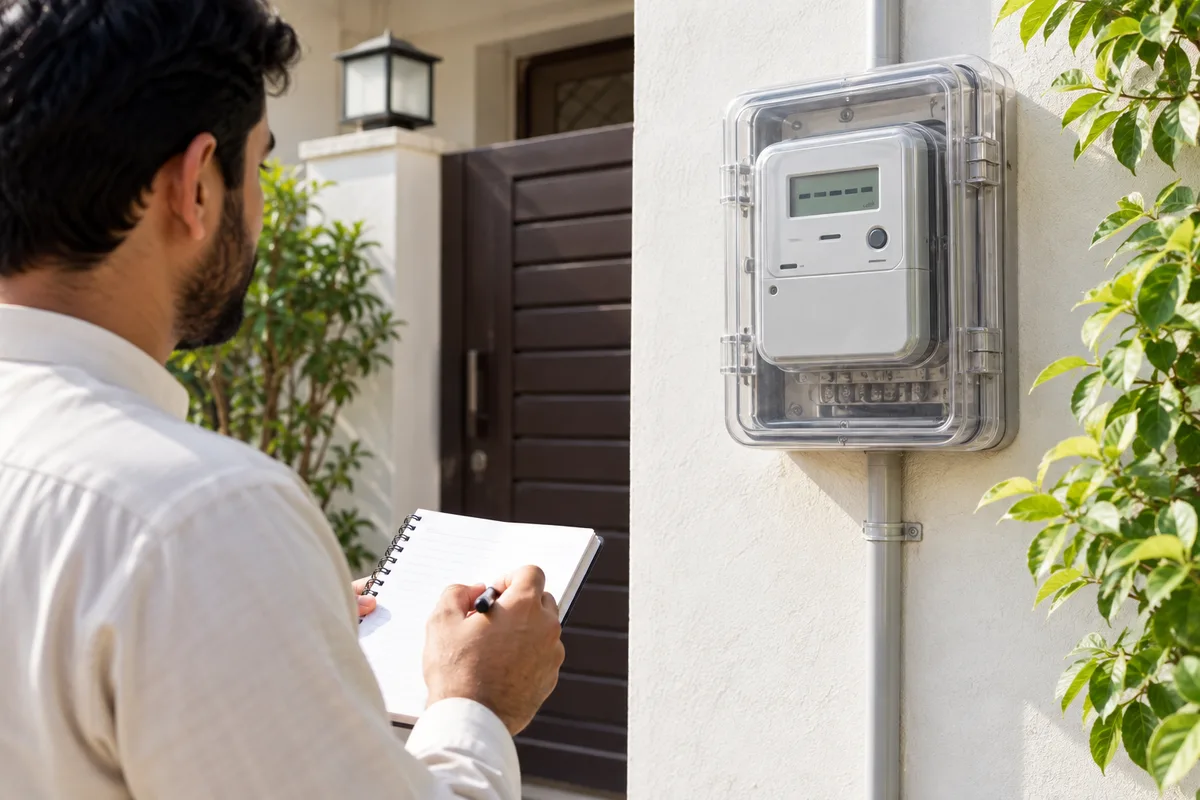
Read the bill before reading the display
Find the tariff category, reading dates, previous and current readings, units, and multiplying factor if one applies. Match each entry to its register label.
Meter displays differ. A device can cycle through energy, demand, voltage, date, time, and other information. Do not assume a display code copied from another meter brand means the same thing on yours. Ask the supplier to identify the register mapping when it is unclear.
Our meter-reading guide covers the basic distinction between a display and billed consumption.
Calculate each interval separately
Consider this invented example, with a multiplying factor of one:
| Register | Previous reading | Current reading | Period units |
|---|---|---|---|
| Peak | 1,200 | 1,260 | 60 |
| Off-peak | 4,500 | 4,740 | 240 |
| Combined | Not a separate subtraction | Not a separate subtraction | 300 |
The total energy is 300 units, but its energy charge depends on how those units are split. You cannot assume all 300 units receive the lower rate.
If an actual account has a multiplying factor, estimated units, meter replacement, or a correction, include those details in the check rather than applying this simplified table unchanged.
Price the units using the applicable rates
Using hypothetical rates of Rs 45 per peak unit and Rs 35 per off-peak unit, the example gives Rs 2,700 for peak energy and Rs 8,400 for off-peak energy. The combined energy charge is Rs 11,100.
Those are invented teaching figures, not a current tariff quotation. The final bill can also contain fixed charges, adjustments, taxes, and balances. Dividing that final payable amount by 300 gives an effective average cost, not necessarily either published energy rate.
Check rates and category conditions on your supplier’s official tariff page, such as the IESCO tariff guide.

Timings depend on the supplier
Use your company’s schedule. IESCO peak hours and K-Electric peak hours have different published seasonal windows. A national graphic without a company and source date can conceal that difference.
Shifting a flexible task can reduce its energy charge where the applicable off-peak rate is lower. It does not reduce the number of kWh used by that task merely because the clock changed.
When a TOU bill needs investigation
Request clarification if the register labels do not match the account, the reading dates are inconsistent, or a meter change is not reflected in the calculation. Keep dated photographs taken from a safe position and the relevant earlier bill.
Ask the company to explain register mapping, clock settings, and any multiplying factor. Do not open the meter or try to reprogram it. For a replaced device, use the old/new meter checklist.
The most useful complaint contains the exact two readings and the calculation you expected. ‘Peak units seem high’ is harder to investigate than a clear mismatch tied to dates and records.
Sources: IESCO tariff guide, K-Electric meter timing specification.
Frequently Asked Questions
What does TOU mean?
Time of use means consumption is recorded and priced according to defined time periods under the applicable tariff. Confirm that your account is billed on that arrangement.
Does every digital meter have a TOU tariff?
No. A digital display alone does not establish the billing category. Read the tariff and consumption fields on the bill.
What are peak units?
They are energy units assigned to the peak register or period under the applicable arrangement. The supplier’s schedule and meter configuration determine that period.
What are off-peak units?
They are energy units assigned to the off-peak period. They are not a discount subtracted from peak consumption; calculate the two categories separately.
How do I calculate period units?
Subtract each register’s previous reading from its own current reading, then account for any applicable factor or billing adjustment. Keep the reading dates consistent.
Can I subtract an off-peak reading from a peak reading?
No. They represent different registers. Cross-subtraction does not produce a meaningful monthly consumption figure.
Is the cumulative meter total my monthly use?
No. A cumulative total can include earlier periods. Monthly use requires the relevant start and end readings or the billed period units.
Can I add peak and off-peak units?
Yes, when they cover the same interval and compatible measurements. Their sum gives combined energy for that interval, not necessarily the final payable bill.
How are the energy charges calculated?
Multiply peak units by the applicable peak rate and off-peak units by the applicable off-peak rate, then combine the energy amounts. Other bill items remain separate.
Can I price all units at the off-peak rate?
No. That would omit the separately priced peak portion on a TOU account. Use the correct rate for each recorded category.
Are the article’s example rates official prices?
No. They illustrate the calculation only. Confirm the tariff category, effective period and actual rates before estimating your own bill.
Do peak hours stay the same throughout the year?
Some suppliers publish seasonal timings. Check the schedule that applies to your supplier and period rather than assuming one year-round window.
Can I use another city’s peak schedule?
Not without verifying that it applies to your supplier and tariff. Similar-looking tables are not proof of identical account conditions.
What if I cannot identify the display codes?
Ask the supplier for the register mapping for your meter model. Codes copied from a different brand can refer to different measurements.
Can the display show things other than energy?
Yes. It may cycle through demand, voltage, time or other information. Match the measurement label before recording a value as kWh.
What if the displayed time seems wrong?
Record the observation safely and report it to the supplier for review. Do not open or attempt to reprogram the meter.
Is MDI part of total monthly units?
No. Maximum demand and energy consumption are different measurements. Read any demand-based charge separately from peak and off-peak kWh.
Does shifting use off-peak remove all charges?
No. It may affect energy pricing where the tariff supports it, but fixed charges, taxes or adjustments can still remain.
What if the meter was replaced mid-month?
Check separate old and new intervals for both registers using the replacement record. One new-meter display value cannot represent the entire earlier period.
What evidence helps with a TOU billing discrepancy?
Keep the bill, reading dates, register labels and safely recorded observations. Ask for the supplier’s register-by-register calculation and any factor or adjustment applied.
Related Guides
- IESCO Peak Hours: Seasonal Timings and How to Check Your TOU Bill
- K-Electric Peak Hours: Karachi TOU Timings and Bill Checks
- Meter Replaced? Check the Old and New Readings on Your Bill
Background reading: Kilowatt-hour on Wikipedia. This explains the general subject; the supplier records and source notes above govern account-specific checks.
Source review: 10 September 2026. Prepared with AI-assisted drafting and checked against the sources named in this guide. BijliBills is an independent information website. The supplier’s current bill, tariff notification, and account instructions take priority.