 Skip to content
Electricity bill installments can help when a large FESCO bill arrives before enough money is available, but paying only part of the amount does not automatically create an approved plan. The practical question is how to request manageable dates without misunderstanding the remaining dues. Contact the responsible FESCO office, explain the account and request a written, approved payment schedule with computerized bills.
This guide explains the documented process and the details to confirm before paying. It does not promise approval or a fixed number of installments for every account. Obtain your current statement through the BijliBills electricity checker and note its existing due date first.
Electricity bill installments: what needs approval?
An installment arrangement divides an amount according to terms accepted by the utility. A request, a verbal conversation and an approved schedule are different stages. Keep evidence of which stage your account has reached.
The NEPRA Consumer Service Manual revised 26 November 2025, section 6.8, states that DISCOs may provide installments and due-date extensions according to their business requirements, and must generate computerized bills when these are allowed. An independent information website cannot approve either facility. Official manual, PDF page 50.
Ask the receiving office to identify the competent officer for your case. Do not rely on an online table claiming that every officer can approve the same amount or number of installments; delegation limits and account circumstances require confirmation.
Installments, an extension and bill correction are different requests
An extension changes an approved payment deadline. Installments divide payment over an approved schedule. A correction changes a bill because an error has been established. You may need clarification on more than one issue, but none automatically grants the others.
If you believe the reading is wrong, say so and prepare the relevant evidence. If you accept the amount but cannot pay it at once, describe the payment difficulty. If both apply, keep the disputed amount and the affordability request distinct.
| Situation | Useful request |
|---|---|
| Amount appears correct but cannot be paid at once | Ask about an approved installment schedule |
| Short additional time would solve the problem | Ask about a due-date extension |
| Reading, category or calculation appears wrong | Request review and correction with evidence |
| A previous payment appears as arrears | Request payment reconciliation with the receipt |
| A notice has already been issued | Ask how the notice and payment request will be handled together |
The bill correction guide can help with a genuine calculation or reading dispute.
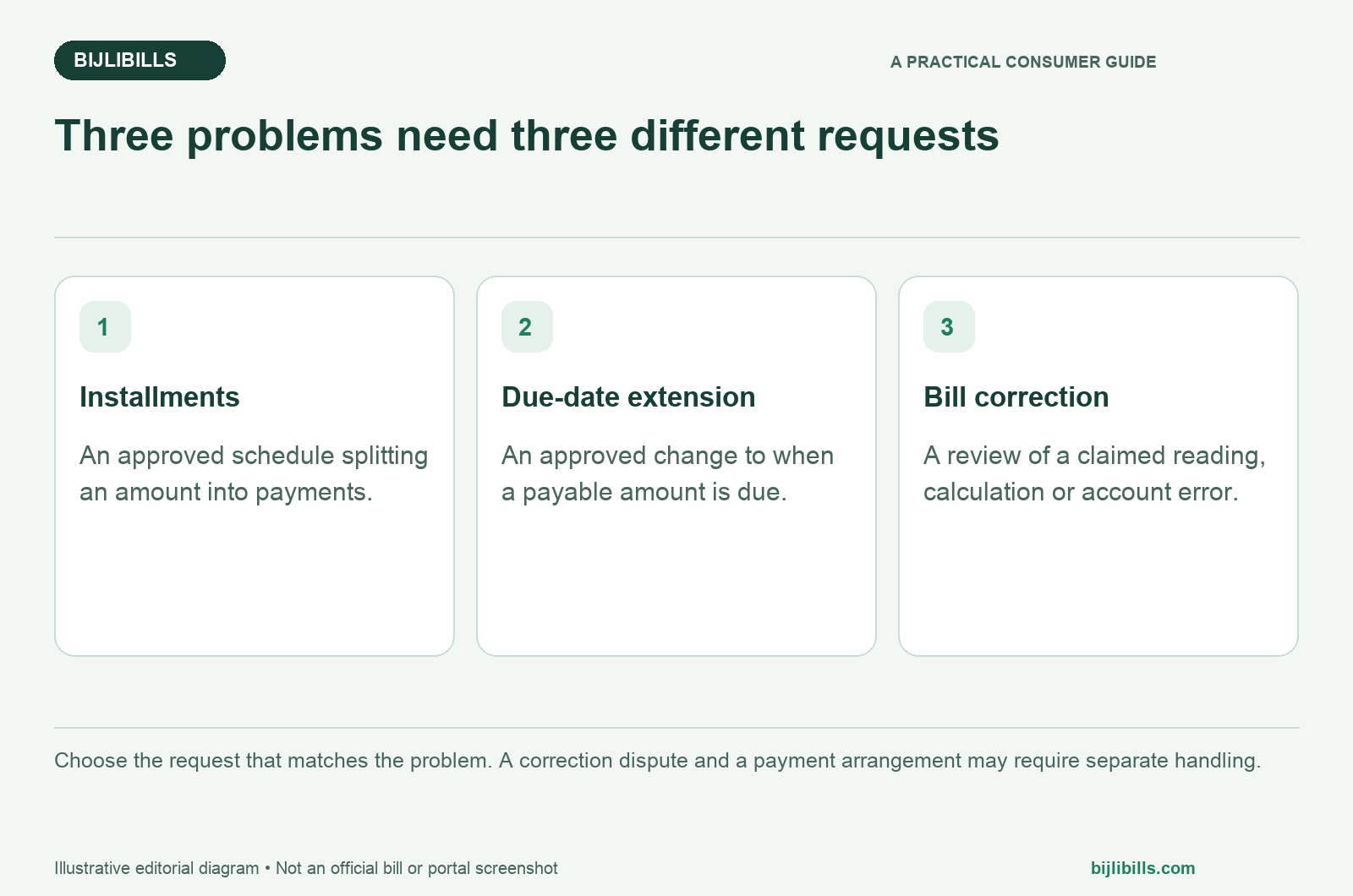
Choose the request that matches the problem. A correction dispute and a payment arrangement may require separate handling.
What the manual says about markup and late charges
For a request concerning the current month's bill, section 6.8.2 provides no markup or late-payment surcharge on the first installment if paid within the due date. It specifies 14% per annum, calculated pro-rata, for the remaining installments. This is a dated rule in the revised manual, not a promise of interest-free installments or a flat 14% addition to the entire bill. CSM section 6.8.
Ask for the actual amounts and dates in writing. The approved schedule should make it clear what each payment covers and whether other current bills remain payable separately. Do not calculate your own discount or subtract a disputed surcharge without an official correction.
The same section says LPS is not imposed where the due date is extended. The essential word is extended: a pending request is not the same as an approved extension.
Prepare your information before visiting or contacting FESCO
Keep the current bill, account reference, consumer name, contact details, recent payment receipts and any relevant notice. Bring identity or authority documents that the receiving office requires for your role, particularly if you are acting for another person.
Write a short explanation of the difficulty and a realistic proposed payment amount and date. Avoid promising installments that would leave the next ordinary bill unpaid. A workable proposal recognises both the existing balance and continuing electricity use.
Do not send original identity documents or a full unredacted bill to an unknown intermediary. FESCO's official FAQ directs billing issues to the relevant subdivision/Revenue Office. Confirm document requirements with that office rather than paying someone for an unofficial “guaranteed approval.”
Step-by-step SOP for an installment request
- Confirm the balance. Match the current bill and receipts so you know whether the amount includes genuine arrears or a disputed payment.
- Record the deadline. Apply before the existing due date where possible; do not assume the application stops the clock.
- Prepare a short written request. Identify the account, bill month, amount, reason and proposed payment dates.
- Approach the responsible office. Ask the subdivision, Revenue Office or customer service facility to route the request to the competent authority.
- Obtain acknowledgement. Keep a receipt, diary number or other evidence showing when and where the request was received.
- Ask about the pending period. Obtain instructions on what is payable while approval is being considered, especially if a notice exists.
- Read the decision. Confirm approved amounts, dates, markup, late charges and treatment of ongoing monthly bills.
- Collect computerized payment documents. Check the account reference and amount on each approved bill or schedule.
- Pay through an authorised channel. Save each successful receipt with the corresponding installment.
- Reconcile the next statement. Make sure payments and remaining balances are reflected correctly; report a mismatch promptly.
For payment-channel preparation after approval, see the FESCO online payment guide.
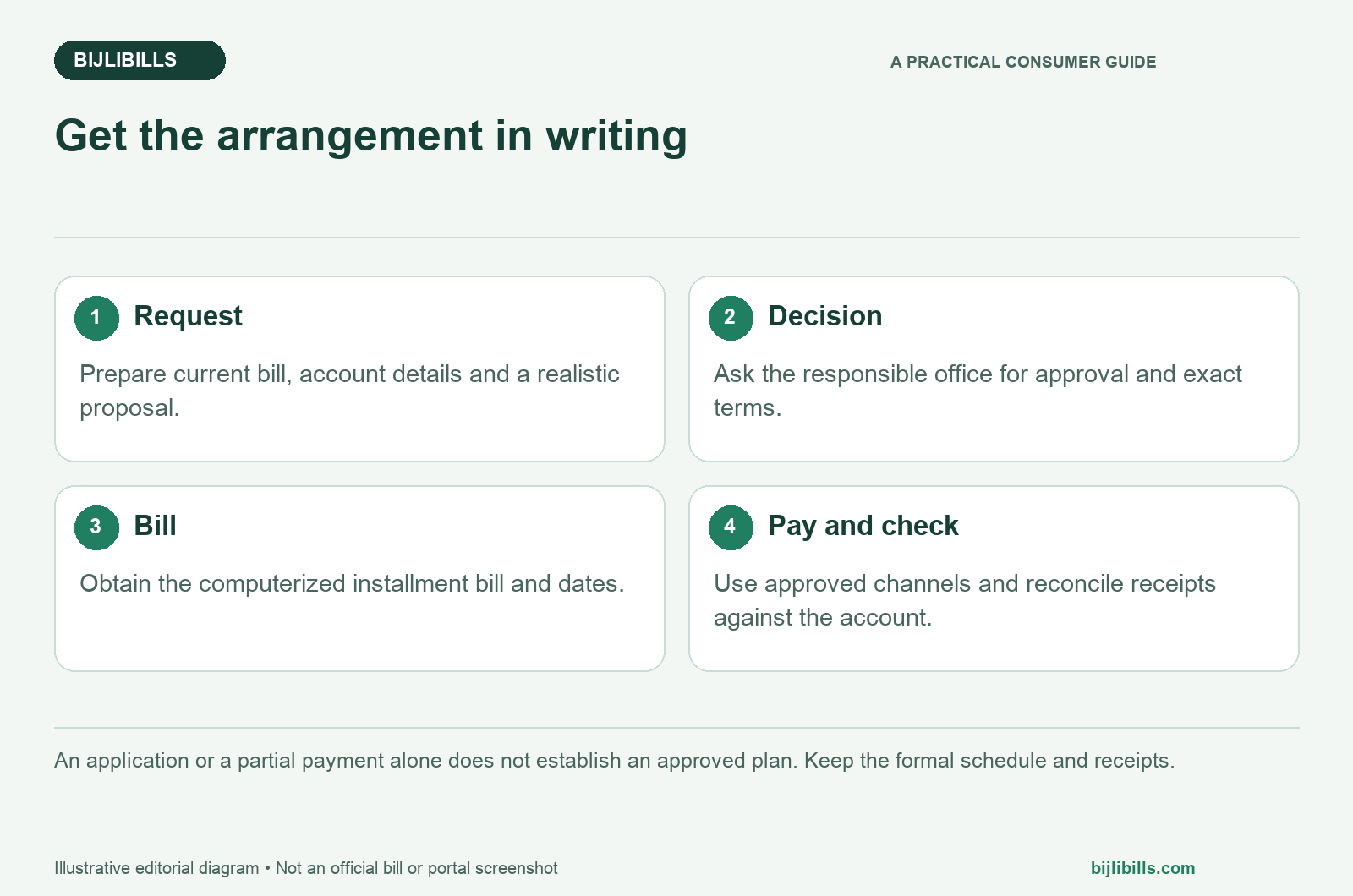
An application or a partial payment alone does not establish an approved plan. Keep the formal schedule and receipts.
A short application you can adapt
Use your own facts in a request such as this:
“To the competent officer: I request consideration of installments for the bill dated [date] on account [reference]. The payable amount shown is [amount]. My difficulty is [brief factual reason]. I propose paying [amount] by [date] and request an approved schedule for the remaining balance. Please confirm applicable charges, continuing monthly-bill obligations and the payment documents I should use.”
Add details of any disputed entry separately and attach supporting copies. The template is a communication aid, not an approved FESCO form or evidence that the request must be accepted. Do not state a reason, relationship or payment promise that is not accurate.
Budget for the plan and the next monthly bill
Suppose, purely as a planning example, a household can spare Rs 6,000 next month, but expects its next normal electricity bill to be about Rs 4,000. Offering a Rs 6,000 installment could leave no money for continuing service charges. The household needs to explain the realistic amount available after its expected essentials.
These figures are illustrative and are not an official schedule. Ask how future adjustments or monthly bills will be handled, whether an installment appears on the regular bill, and which reference to use when paying.
Missing an agreed payment can have consequences under the arrangement. If circumstances change, contact the office before the date rather than silently changing the schedule. The after-due-date payment guide explains which information to check if a deadline has already passed.
If the request is delayed or declined
Ask for the status or decision and its reason. A more realistic proposal, missing evidence or a different authorised facility may be relevant, but none guarantees approval. Keep the original deadline and any formal notice visible while you seek clarification.
For a service complaint about handling, use the genuine PITC CCMS channels. The portal lists 118, SMS 8118 and its complaint routes. Do not transfer money to a personal account to secure installments, cancel arrears or prevent disconnection.
Frequently asked questions
1. Does paying half the bill create an installment plan?
No. A partial payment is not evidence of approval. Obtain the authorised schedule and payment instructions before assuming the balance is deferred.
2. Is an installment request automatically approved?
No. Approval depends on the competent authority and applicable requirements. An acknowledgement confirms receipt, not acceptance.
3. Can BijliBills approve my request?
No. BijliBills is an independent guide. The electricity company handles account decisions, payment arrangements and corrections.
4. Are all installments interest-free?
No. The cited manual provides pro-rata annual markup for remaining installments of the current-month arrangement described in section 6.8.2.
5. Does 14% per annum mean a flat 14% bill charge?
No. Annual pro-rata treatment is different. Ask for the approved amounts and calculation rather than adding a flat percentage yourself.
6. Can I choose any number of installments?
You may make a proposal, but the approved number and dates must come from the responsible authority.
7. Does applying extend the due date?
No automatic extension should be assumed. Obtain the written decision and confirm what must be paid while the request is pending.
8. Can a tenant request payment assistance?
Ask the responsible office what authority and documents it requires for that account. Do not assume tenancy removes account-verification requirements.
9. What if the bill includes a payment I already made?
Provide the receipt and request reconciliation. Keep that correction issue separate from asking to divide a genuinely outstanding balance.
10. Must I still pay new monthly bills?
Confirm this explicitly in the approved arrangement. Do not assume an installment plan covers all future consumption automatically.
11. Can an installment be paid through a wallet?
Use the channel and computerized payment document accepted for the approved arrangement. Verify the displayed reference and amount before authorising payment.
12. What if an approved installment does not appear correctly?
Keep the written schedule and payment evidence, then ask the billing office to reconcile the account before making assumptions about the balance.
13. Can an intermediary guarantee approval for a fee?
Treat such a promise cautiously. Use official channels and never transfer money to an individual's account for a purported bill adjustment.
14. What if I cannot meet an agreed installment date?
Contact the responsible office before the deadline and request guidance. Do not unilaterally alter the approved dates or amounts.
15. Which documents should I keep after completing the plan?
Retain the approval, computerized bills, every payment receipt and the later statement showing how the account balance was reconciled.
Make the arrangement clear before making assumptions
A useful installment plan has approved amounts, dates, charges and payment documents. Apply with accurate records, budget for continuing bills, and verify that each payment reaches the correct account.
Pingback: LESCO Bill Installments: What to Ask Before You Pay