 Skip to content

Protected vs unprotected consumers can face different electricity charges even when their latest bills show similar units. For a FESCO household, that can be frustrating: you reduced usage this month, yet the category did not change. Is the bill necessarily wrong? Start by checking the tariff arrangement and the relevant monthly history, because one low reading does not establish eligibility by itself.
This guide explains the officially documented definition, shows why an average can be misleading, and gives you a practical evidence checklist. Get your statement through the BijliBills electricity checker and compare records from the same connection.
Protected vs unprotected consumers: the documented definition
FESCO's tariff terms notified on 13 January 2026, Annex V, define the protected category around non-ToU residential consumption of no more than 200 kWh each month consistently over the preceding six months. Residential non-ToU consumers outside that definition are described as unprotected. The distinction is therefore not merely whether the latest bill happens to be below 200 units. Official FESCO tariff terms, PDF page 44.
FESCO's later tariff schedule effective 12 February 2026 still displays separate protected and unprotected residential rows. The January definition and February price schedule answer different questions: eligibility versus charges. Confirm your actual classification with FESCO where account changes or disputed readings are involved.
Protected does not mean protected from every tax, adjustment or future tariff change. Lifeline and ToU are also separate classifications with their own conditions. Do not treat any of those terms as interchangeable.
Why a six-month average can give the wrong answer
Consider these fictional monthly records for otherwise comparable non-ToU residential accounts:
| Month | Household A | Household B |
|---|---|---|
| 1 | 170 | 120 |
| 2 | 185 | 160 |
| 3 | 190 | 220 |
| 4 | 180 | 150 |
| 5 | 195 | 180 |
| 6 | 175 | 170 |
Every listed month for Household A is within 200 units. Household B has one month above it, despite an average below 200. The wording “consistently” is why averaging the six values is not an adequate substitute for examining each month.
This example illustrates the history test; it is not a decision on either real account. Tariff type, timing of the review and any officially corrected records still matter. Ask which billing periods FESCO used if the status on your bill seems inconsistent with your records.
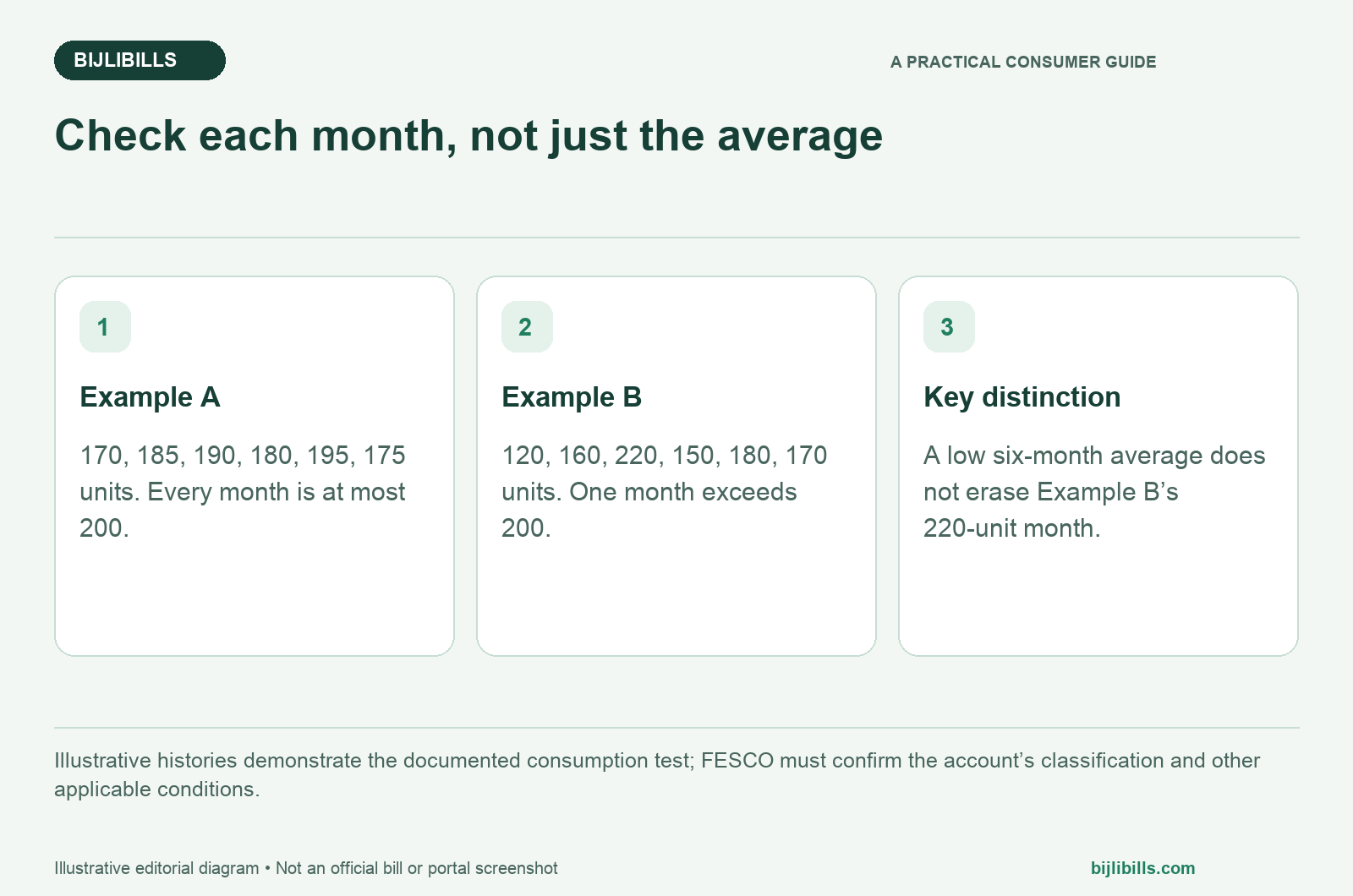
Illustrative histories demonstrate the documented consumption test; FESCO must confirm the account’s classification and other applicable conditions.
Check the tariff before checking the threshold
A household can see low consumption on a connection that is not part of the non-ToU protected framework. The FESCO terms distinguish residential arrangements by sanctioned load and discuss ToU metering for loads of 5 kW and above.
Read the approved category and load instead of inferring them from the building's size or number of residents. The number of phases or a digital display is not a complete explanation of the billing arrangement.
Use the peak and off-peak bill guide if the statement separates those units. A business connection should also be assessed under its approved tariff, not a household rule selected because it gives a lower result.
Step-by-step SOP for checking your category
- Identify the account. Match reference number, address and meter number across the bills.
- Read the tariff code and load. Establish whether the non-ToU residential category is relevant.
- Collect the monthly history. Record the relevant periods individually, with units and reading dates.
- Use corrected records where applicable. Keep both the original disputed bill and the official correction, rather than silently replacing your own worksheet value.
- Flag months over the threshold. Do not hide an excess by averaging it with a low month.
- Check unusually long reading periods. Note when the interval differs and whether an official pro-rata adjustment or carry-forward appears.
- Ask FESCO for the classification basis. Request the periods and figures used for the account if the result remains unclear.
- Submit specific evidence of an error. Explain which reading or classification is disputed and attach supporting records privately.
- Check the next issued statement. A complaint acknowledgement alone does not prove that the category was corrected.
The electricity bill history guide explains how to organise older records when you have not saved every full statement.
What if a delayed reading pushed the units higher?
A longer reading period deserves a separate check. Do not simply change the billed units yourself, but do not ignore the dates either.
The NEPRA Consumer Service Manual revised 26 November 2025, section 6.1.1.1, describes pro-rata treatment when a billing cycle exceeds the defined period because of force majeure or an unforeseen situation. Its protected-consumer example illustrates splitting consumption between the current and following billing cycle while preserving the category in the stated circumstances. This is a specific rule, not permission to choose any favourable reading period. Official manual, PDF pages 45–46.
Record scheduled and actual reading dates, the billed units and any carry-forward entries. The billing-days and pro-rata guide provides a practical way to arrange that evidence before asking FESCO to review it.
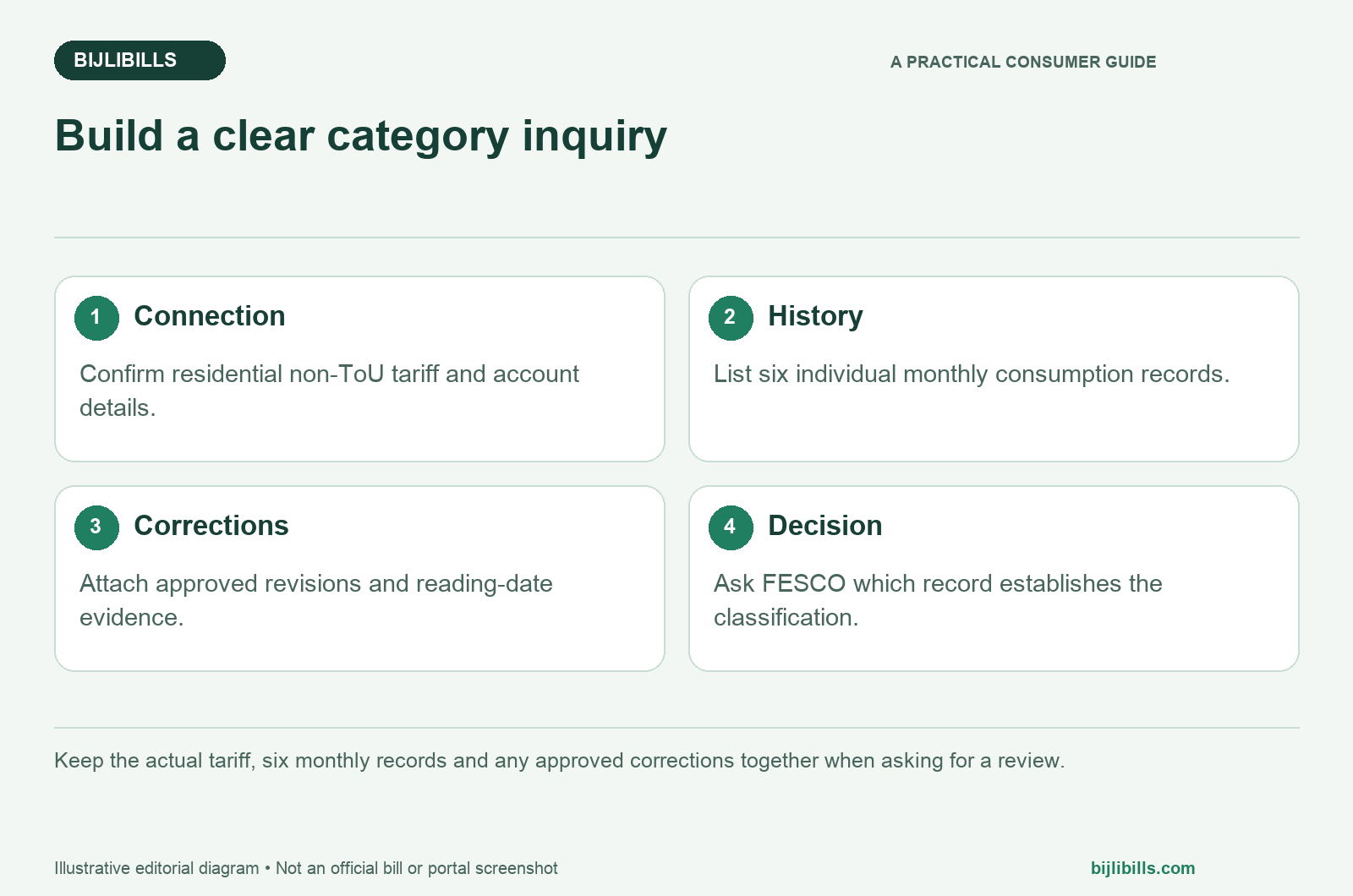
Keep the actual tariff, six monthly records and any approved corrections together when asking for a review.
How to raise a classification concern clearly
A focused request is easier to investigate than a general complaint about a high bill. State the bill month, printed category, relevant historical units and the exact month or reading you believe is wrong.
For example: “Please explain which monthly records were used to classify this account, and review the attached correction for the disputed month.” That asks for a checkable response without assuming the outcome.
If the units themselves are incorrect, request their correction with meter photographs and the relevant dates. A request merely to reduce accurately recorded consumption below a threshold is different from correcting a genuine error. Do not alter meter readings, tamper with equipment or pay an intermediary promising to change status.
Plan consumption without treating a forecast as approval
Regular meter records can help a household notice a rising daily pattern before the next bill. Compare the same register from week to week and note changes in occupancy or appliance use.
A projection is still a projection. It cannot guarantee protected status, because the actual billing record and applicable conditions control classification. Keep enough margin in a household budget to account for uncertain consumption and other bill components.
If you are comparing potential savings, use the correct category and all relevant charges. Changing one checkbox in a calculator does not change the utility account. It also does not prove an entitlement to a rebate or a particular future price.
Frequently asked questions
1. Is using fewer than 200 units this month enough?
Not by itself. The documented definition also concerns non-ToU residential classification and consistent monthly history over the relevant six-month period.
2. Does exactly 200 units satisfy the consumption threshold?
The cited definition uses “no more than” 200 kWh. Other eligibility conditions and the relevant account history must still be checked.
3. Can I average six months to establish eligibility?
No. An average can conceal a month above the threshold. Examine each monthly record under the definition's consistency requirement.
4. Does protected mean lifeline?
No. They are separate tariff descriptions with different conditions. Do not select a lifeline price solely because your bill is low.
5. Are protected consumers exempt from every adjustment?
No blanket exemption follows from the label. Read the particular adjustment notification and its stated eligible or excluded categories.
6. Can a tenant have a protected account?
Tenancy alone does not answer the tariff question. Check the connection's category, official history and the conditions applied to that account.
7. Does changing the consumer name erase usage history?
Do not assume it does. Ask FESCO how the approved change affects the existing account and retain prior statements.
8. Can an online checker change my category?
No. It displays or opens billing information. Account classification and corrections are handled through the utility's authorised process.
9. What if an earlier month's reading was corrected?
Keep the formal correction and ask whether the revised figure was used in the status review. A private calculation is not equivalent.
10. Will a lower bill next month prove status was restored?
Not necessarily. Read the category and calculation; consumption or adjustments could have changed while the classification remained the same.
11. Does a ToU connection use this same protected test?
The cited definition specifically concerns non-ToU residential consumers. Verify the account arrangement before applying that test.
12. What should a new consumer check?
Ask FESCO how eligibility is assessed while sufficient account history is unavailable. Do not invent past periods or assume automatic protection.
13. Can a long billing period be challenged?
Record the actual dates and ask whether applicable pro-rata provisions were followed. An unusual period needs evidence and official review.
14. Should I stop paying while status is disputed?
Do not assume a complaint changes the deadline. Seek written clarification about payment, any approved extension and the disputed amount.
15. What proves the classification was corrected?
Look for an official account response and corrected or subsequent bill reflecting the change. A ticket alone confirms only that an issue was recorded.
Check the record, then question the specific mismatch
Protected status is a classification with documented conditions, not a reward selected on a calculator. Compare the correct monthly history and tariff, preserve any corrections, and ask FESCO to explain the exact figure that does not agree with your evidence.