 Skip to content

An electricity bill correction starts with a specific mismatch, not simply a total that feels too high. Your bill may show an incorrect reading, the wrong meter details, a calculation problem, or a payment carried forward as arrears. To request a useful review, compare the bill with dated records, identify the disputed field, and send the evidence to the company responsible for the connection.
This guide explains that process for Pakistani consumers, with a FESCO wrong-meter-reading example. It helps you prepare a clear complaint; BijliBills cannot edit a company’s ledger or approve a reduction.
Identify what needs correcting
Start with a fresh copy of the bill, obtained through your company’s service or the BijliBills checker. Make sure you are investigating the correct connection and month. A saved bill from another property can create a convincing but misleading comparison.
| Suspected problem | Evidence to compare | Request to make |
|---|---|---|
| Wrong current reading | Bill reading, dated meter image and register identity | Review the recorded reading and billed units |
| Wrong previous reading | Previous bill and current bill | Explain the opening reading used |
| Incorrect meter details | Meter serial and connection records | Confirm which meter the bill covers |
| Paid amount shown again | Original paid bill and provider evidence | Reconcile the earlier payment |
| Unclear average assessment | Bill remark and meter-condition report | Explain the assessment basis and relevant period |
| Unexpected tariff or load | Approved connection details and tariff code | Review the category or account entry |
Section 6.4.1 of the NEPRA Consumer Service Manual, revised 26 November 2025 identifies the main billing fields. Checking these separately prevents a tax or previous balance from being mistaken for a reading error.
How to prepare an electricity bill correction request
- Confirm the account. Compare the company, reference number, service address and meter number with your records.
- Record the disputed entry. Write down the exact reading, units, amount or billing remark you believe needs review.
- Check the dates. Note the previous reading date, current reading date and date of any photograph you take.
- Collect relevant evidence. Keep the current bill, previous bill, clear meter photograph and any payment or meter-replacement record that relates to the issue.
- Prepare a short comparison. State what the bill shows, what your evidence shows and the question you need answered.
- Submit through the proper channel. For FESCO, its official FAQs direct wrong-bill concerns to the relevant subdivision or Revenue Office. An online complaint can also be recorded through PITC CCMS.
- Keep an acknowledgement. Save the ticket or receiving details, then check both the response and any revised bill before treating the case as complete.
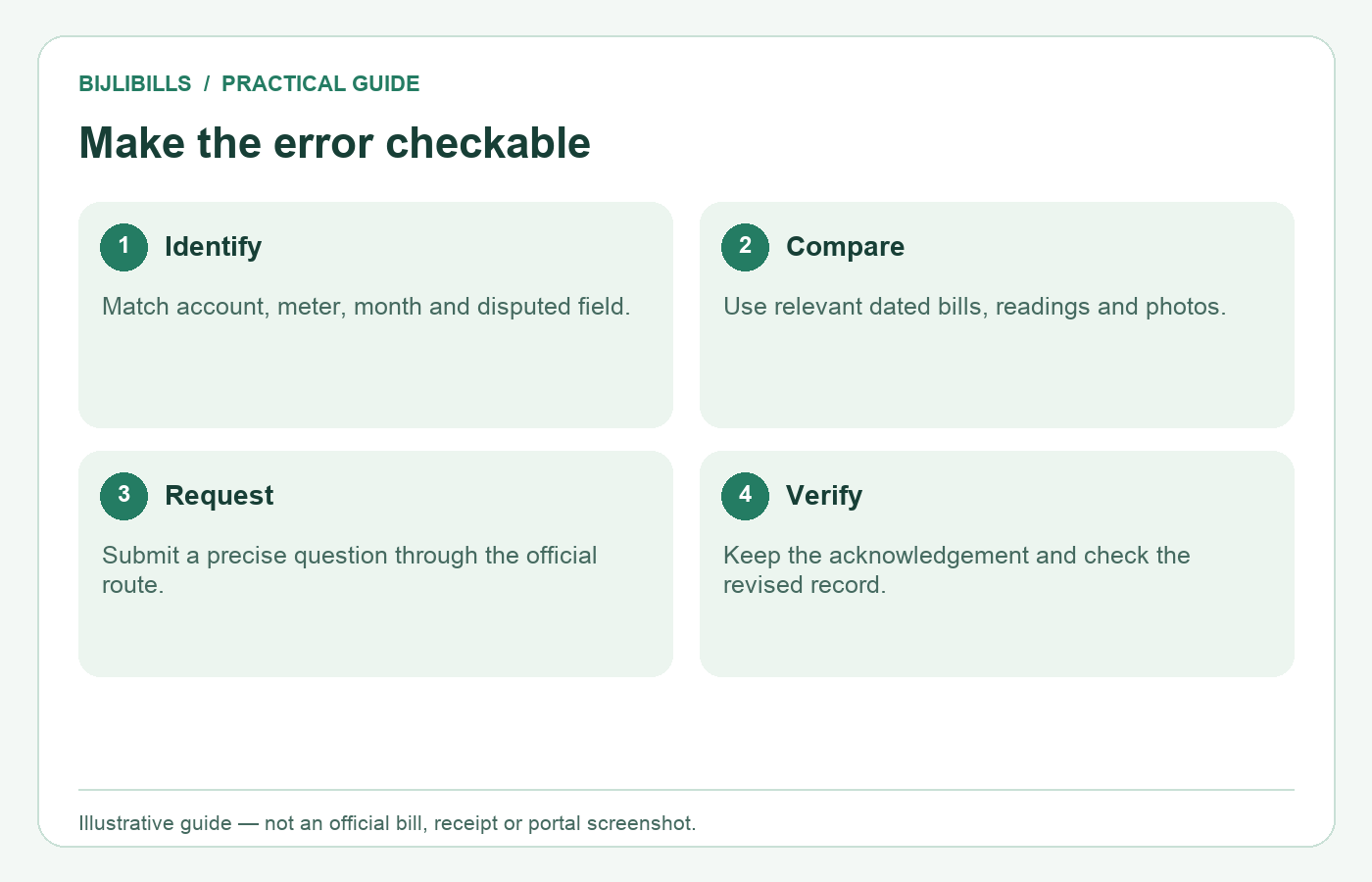
A preparation checklist, not an official FESCO application form.
Compare readings without creating a new error
A meter photograph taken today does not necessarily match the reading printed on a bill from an earlier date. Compare the same meter, the same register and the appropriate reading dates. If the meter cycles through several displays, do not assume the first visible number is the register used on the bill.
For an illustrative single-register example, assume the previous reading is 12,450 kWh, the current reading is 12,690 kWh, and the multiplying factor is 1. The difference is 240 kWh. That calculation checks the reading arithmetic; it does not establish the complete payable bill or the correctness of every charge.
If the bill shows different registers for peak and off-peak consumption, compare each corresponding pair. Do not subtract a peak reading from an off-peak reading. Our guide to reading an electricity meter explains how to organize the information without guessing display codes or factors.
The revised manual addresses meter-reading snapshots in section 6.1.3. Where a snapshot is available on the bill or official record, compare its date and meter identity with your evidence. A photograph can support a question; it is not automatically proof that every later billed unit is wrong.
Write a complaint an officer can investigate
Keep the request factual and short. For example:
Please review the current reading on my October bill. The bill shows [reading] for [reading date]. My dated photograph shows [reading] on [photo date], and the meter serial is [serial]. The previous bill shows [previous reading]. Please confirm the reading record, explain the difference, and issue a corrected bill if an error is established.
Use your actual details through a private official channel. This is an illustrative writing template, not a customer account or a promise that the complaint will be upheld.
Attach a small, readable set of records rather than dozens of unrelated screenshots. Name the files by purpose, such as current-bill.pdf, previous-bill.pdf and meter-photo-date.jpg. Keep originals intact, and avoid editing the photograph in ways that obscure its context.
Ask one clear question for each disputed item. “Please explain the assessment period” is more useful than “remove everything extra.” If you believe several entries are wrong, number them so the response can address them individually.
Average bills, replacement meters and paid arrears
A defective or replaced meter needs different evidence from a simple transcribed-reading mistake. Chapter 4.3 of the revised manual contains a separate procedure for defective or burnt meters. Do not assume that every average assessment is a theft allegation, or that subtracting visible readings will resolve every replacement-period bill.
Keep the old meter’s final reading and the new meter’s initial record where available. Ask which dates and readings were used for each part of the bill. Do not open the meter enclosure, interfere with seals, or attempt a repair yourself.
If the disputed amount is a payment carried forward, concentrate on the payment month, reference and original receipt. Section 10.3.1(i) addresses inclusion of previously paid amounts in a later bill. Our money deducted but bill unpaid guide helps when the banking and electricity-company records do not agree.
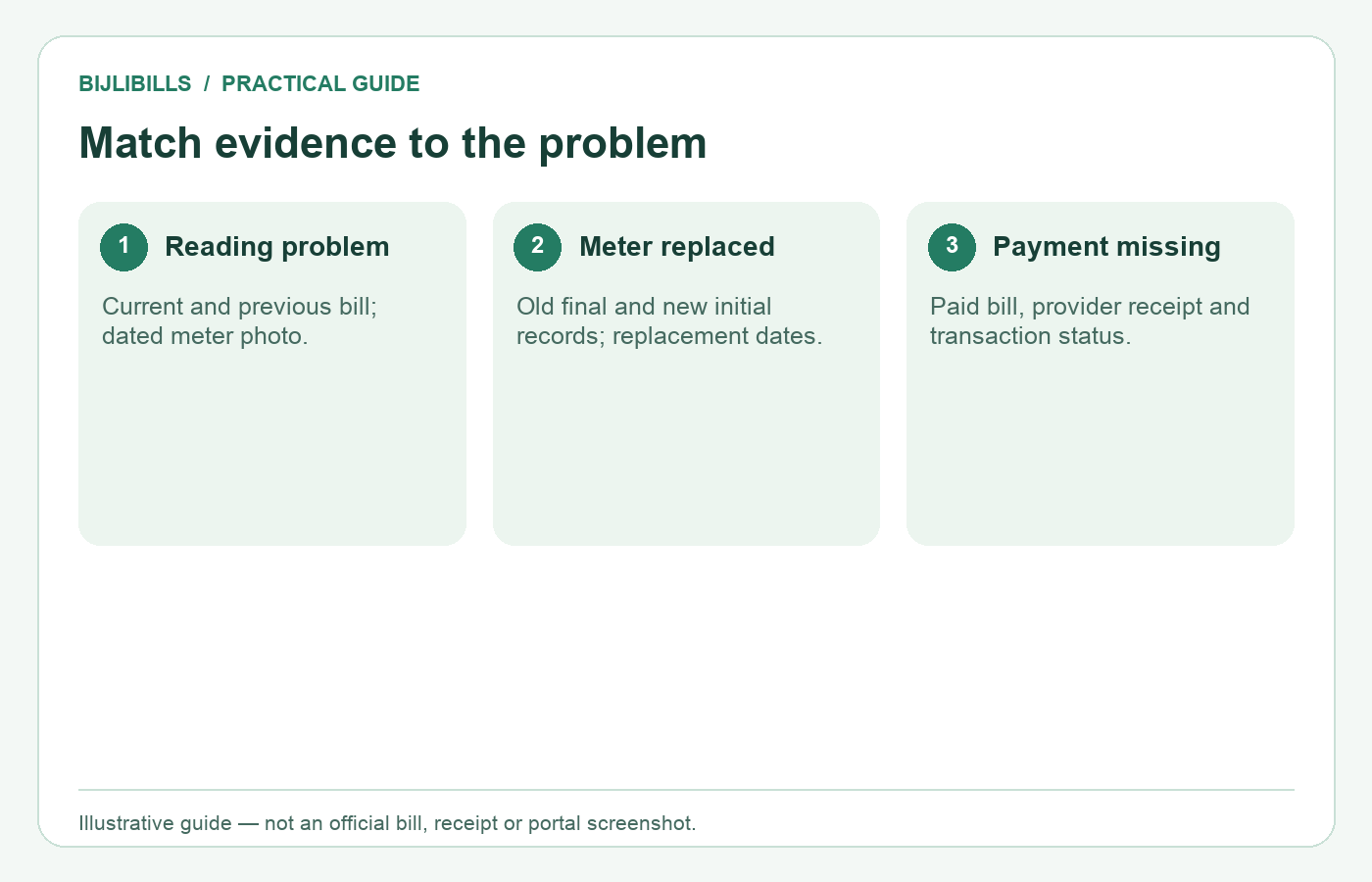
Different problems need different supporting records; one generic complaint may miss the important evidence.
Follow up without losing track of the due date
For incorrect readings or calculations, section 10.3.1(a) of the manual provides a seven-day redressal or reply standard. That is a regulatory standard, not a guarantee that every complaint produces a reduction within seven days.
Record when the complaint was received and what response was given. A closed ticket does not by itself prove that the bill was amended. Compare any new bill with the original disputed fields and ask about an unexplained balance.
A complaint is not automatically a due-date extension or a stay on recovery. Ask for written instructions about payment while the review proceeds. If an extension or installment is approved, use the official revised arrangement rather than privately changing the amount on a PDF.
If the matter remains unresolved, the NEPRA complaint form asks whether the consumer first approached the distribution company and requests the outcome and supporting records. Our PITC complaint tracking guide explains how to keep that history organized.
Frequently asked questions
Can I request correction before paying the bill?
You can report the suspected error, but also ask what payment instructions apply while it is reviewed. Do not assume the complaint changes the due date.
Is a high bill enough evidence of a wrong reading?
No. Compare consumption, reading period and separate charges. A larger total can have several causes that need different checks.
Should I photograph the meter every hour?
A clear dated record relevant to the disputed period is more useful than many unexplained images. Keep observations consistent and identify the register.
What if the meter display is unreadable?
Report that condition to the company and ask for its inspection procedure. Do not remove covers or disturb seals to obtain a photograph.
Can a tenant submit the concern?
Ask the official channel what authority and account information it needs. Keep the registered consumer or landlord informed where appropriate.
Must I send every bank statement I have?
No. Provide only the payment evidence relevant to the dispute, through the authorized channel, with unrelated transactions removed from copies where appropriate.
What if the meter was replaced between the two bills?
Use the replacement record and ask how old and new readings were combined. Treating them as one continuous register can produce a false difference.
Can I correct the bill through a public PDF editor?
Editing your copy does not change FESCO’s account. Request an official correction and retain the revised record issued after approval.
Should I submit the same complaint under several categories?
Choose the category that describes the issue and explain related points in the details. Refer to the existing ticket when following up.
What if I discover a second error later?
Tell the handling office or support channel and ask whether it should be added to the case or recorded separately. Preserve both sets of evidence.
Does a complaint ticket prove the reading was accepted as wrong?
No. It records receipt of a complaint. Look for the investigation outcome and a corrected bill where an amendment is approved.
Can I use a neighbour’s low bill as my calculation?
It does not establish your account’s units, category, load or previous balance. Base the request on your own connection records.
What if the response explains the charge but I disagree?
Ask for the relevant calculation or rule in writing, retain the response, and use the appropriate review channel with specific remaining questions.
Is a detection bill handled exactly like a routine typo?
No. Detection assessments have distinct notice and review provisions. Identify the notice type and do not ignore its stated response requirements.
How do I verify that the correction is complete?
Compare the revised reading, units, adjustment and payable amount with the written outcome. Keep both versions so later balances can be checked.
Turn the concern into a checkable request
An accurate account identifier, a dated comparison and a clear question make a bill dispute easier to investigate. Preserve the original evidence, use the official correction route, and verify the resulting record instead of relying only on a reassuring message.
Pingback: Electricity Meter Accuracy Test: How to Prepare a Meter Challenge - Bijli Bills
Pingback: Meter Reading Delayed? Check Billing Days and Pro-Rata Units - Bijli Bills