 Skip to content

Checking electricity bill paid status means connecting the bill to a specific transaction. You paid your FESCO Bill, but the bill still appears online and somebody in the household is asking whether it needs paying again. The document remaining available is not proof of failure. Start with the payment provider's transaction record, match it to the correct FESCO account, and then investigate any unresolved utility balance separately.
A bill, a successful payment receipt and a utility account entry are different pieces of evidence. This guide explains how to read them together, organise a payment check and avoid a second payment made only out of uncertainty. BijliBills provides independent guidance; it cannot mark a bill paid or alter FESCO's records.
These checks are useful across Pakistani electricity companies because a bill document, a payment-provider receipt and a utility account entry answer different questions. FESCO is the example here. For another provider, use its own account service and support channels when confirming whether a payment has been applied.
What does “electricity bill paid status” actually mean?
The phrase can refer to the state of a transaction inside a bank or wallet, a biller's response during an attempted payment, or the account information held by the electricity company. Those systems should not be treated as one identical screen.
The official FESCO bill portal is a way to retrieve the bill using the supported account identifiers. A downloaded copy is a snapshot. It does not change on your phone after a later payment, and it is not a bank receipt.
| Evidence | What it can show | What to check before relying on it |
|---|---|---|
| Detailed provider receipt | Transaction amount, date, reference and reported outcome | Correct biller and account, plus the actual status |
| Balance deduction | Money has left or been held in the payment account | Whether the associated transaction completed, failed or reversed |
| Confirmation message | A provider acknowledgement | Authentic sender, matching transaction and complete details |
| FESCO account or later bill record | How amounts appear in the utility record | Relevant billing month, account and any unresolved posting issue |
| Old downloaded bill | The bill document previously saved | It is not a live payment-status screen |
No single screenshot should be interpreted beyond what it actually displays. A message saying “processing” is not the same as a completed transaction.
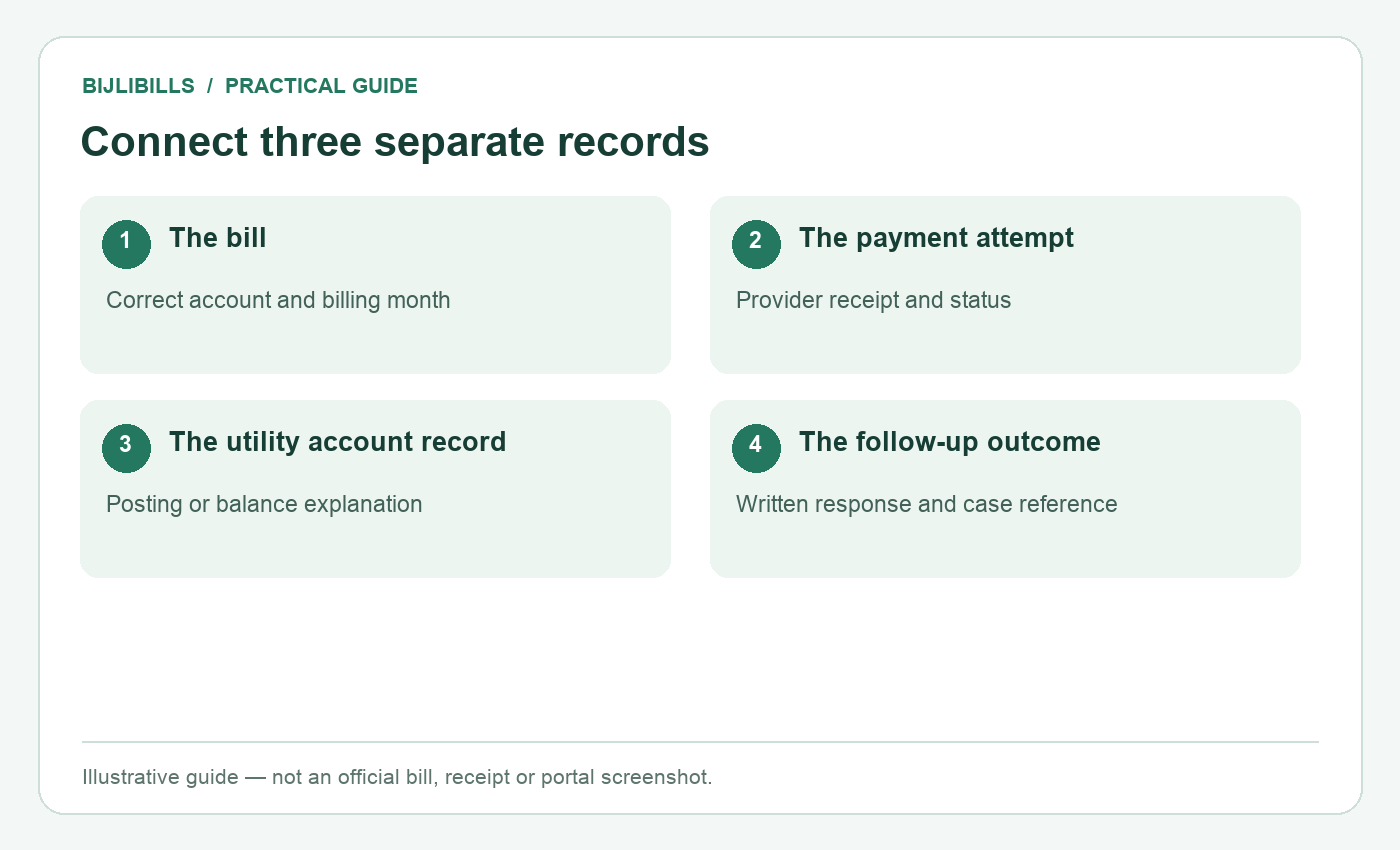
Illustrative workflow: connect three separate records. This is not an official bill or portal screenshot.
Step by step: verify a FESCO Bill payment
- Find the original bill or retrieve it through the BijliBills company selector. Confirm the reference, premises and billing month.
- Open the payment provider you used, rather than starting another payment in a different app.
- Locate the relevant transaction in its history. Check the electricity company, account reference, amount, date and outcome.
- Open or download the detailed receipt if available. Keep the transaction ID and any confirmation number.
- Compare the identifiers with the bill, including leading zeros and any masked digits that can be checked.
- If the provider reports pending, failed or reversed, follow its support instructions to establish what happened before retrying.
- If the provider reports success but a FESCO balance remains disputed, ask for a trace using the receipt and relevant account information.
- Record the result for other people who manage the same connection, so nobody pays again without checking.
This procedure verifies a real transaction. It does not require your PIN, password or OTP to be shared with a website, relative or support caller.
Interpret the provider's transaction state
Use the wording in your own provider's record. “Successful” indicates its reported completion of that transaction; keep the details if the utility posting later needs investigation. “Pending” means you should obtain the provider's next instruction rather than assume success or failure.
A “failed” transaction can still require checking for a debit or reversal. If money was deducted, ask the provider to explain the treatment of that specific transaction. A general promise on an unrelated blog cannot establish when your funds will be returned.
“Reversed” or “refunded” also needs context. Compare the transaction and account history to confirm which attempt the entry relates to. If two similar payments were attempted, the returned amount may correspond to only one of them.
The official JazzCash payment guide and Easypaisa bill-payment guidance describe their service flows. Use your own provider's support route for transaction-specific information rather than assuming another wallet's procedure applies.
Why the original bill can still be visible
A saved PDF remains the document downloaded at that time. Opening it after payment does not make it a live account statement. Check whether you are viewing a local file, a previous screenshot or a newly retrieved official document before interpreting its contents.
Even a newly opened bill should be read according to its actual fields. The amount printed for a billing period and the evidence that a payment was received serve different purposes. Do not treat a bill's continued availability as an instruction to pay again automatically.
If an amount appears as arrears in a later bill despite a successful payment, collect both bills and the payment evidence. The NEPRA Consumer Service Manual revised in November 2025 addresses complaints involving amounts already paid being included in a subsequent bill. The relevant office must assess the actual records; the existence of a complaint route does not mean every disputed amount will be removed.
Match the payment to the right account
A receipt showing FESCO and the expected amount is still incomplete evidence if the reference belongs to another property. Compare the account identifier, not just the provider logo or a saved nickname such as “home.”
For a practical example, imagine two family connections each owing approximately Rs 6,000. A relative sends a receipt for one, and another person assumes both are paid. The amount and date look plausible, but the reference establishes which connection received that transaction. This is a fictional record-keeping example, not a real consumer case.
Keep application tracking IDs, meter serials and electricity references separate. The reference number and Customer ID explanation helps identify the bill account. The transaction ID is a different reference used to trace the payment attempt.
When a receipt masks part of the account identifier, use the provider's detailed record or official support to resolve uncertainty. Do not guess that the hidden digits match.
A focused follow-up request
Prepare the bill for the relevant month, the successful or disputed payment receipt, the transaction ID, date, amount and correct account reference. If a later bill shows arrears, include that document and identify the exact line you question.
Ask the payment provider to confirm the transaction's outcome and biller reference. Ask FESCO to check the posting against the correct connection where necessary. These are related but distinct requests, and each organisation may need different evidence.
The PITC complaint service provides official complaint channels. Keep any ticket or written acknowledgement and record who gave instructions. There is no universal FESCO posting deadline verified for every provider in this guide, so do not assume every discrepancy must disappear after a fixed number of hours.
For a deduction with no clear successful payment, use the money deducted but bill unpaid guide. For a confirmed duplicate attempt, use the bill paid twice guide and preserve both transaction records.
Keep a shared household payment log
A simple private log can contain the connection label, billing month, amount, payer, transaction status and receipt location. Use “pending investigation” when appropriate rather than marking the bill paid because somebody remembers pressing a button.
Link the log to the original documents stored privately. If a reversal or correction occurs, update the note and retain the earlier evidence explaining the change. That is more useful than deleting the confusing entry and relying on memory.
Tell other authorised household members when the payment is confirmed or under investigation. Clear coordination reduces accidental second payments, particularly when a tenant and landlord both monitor the same connection.
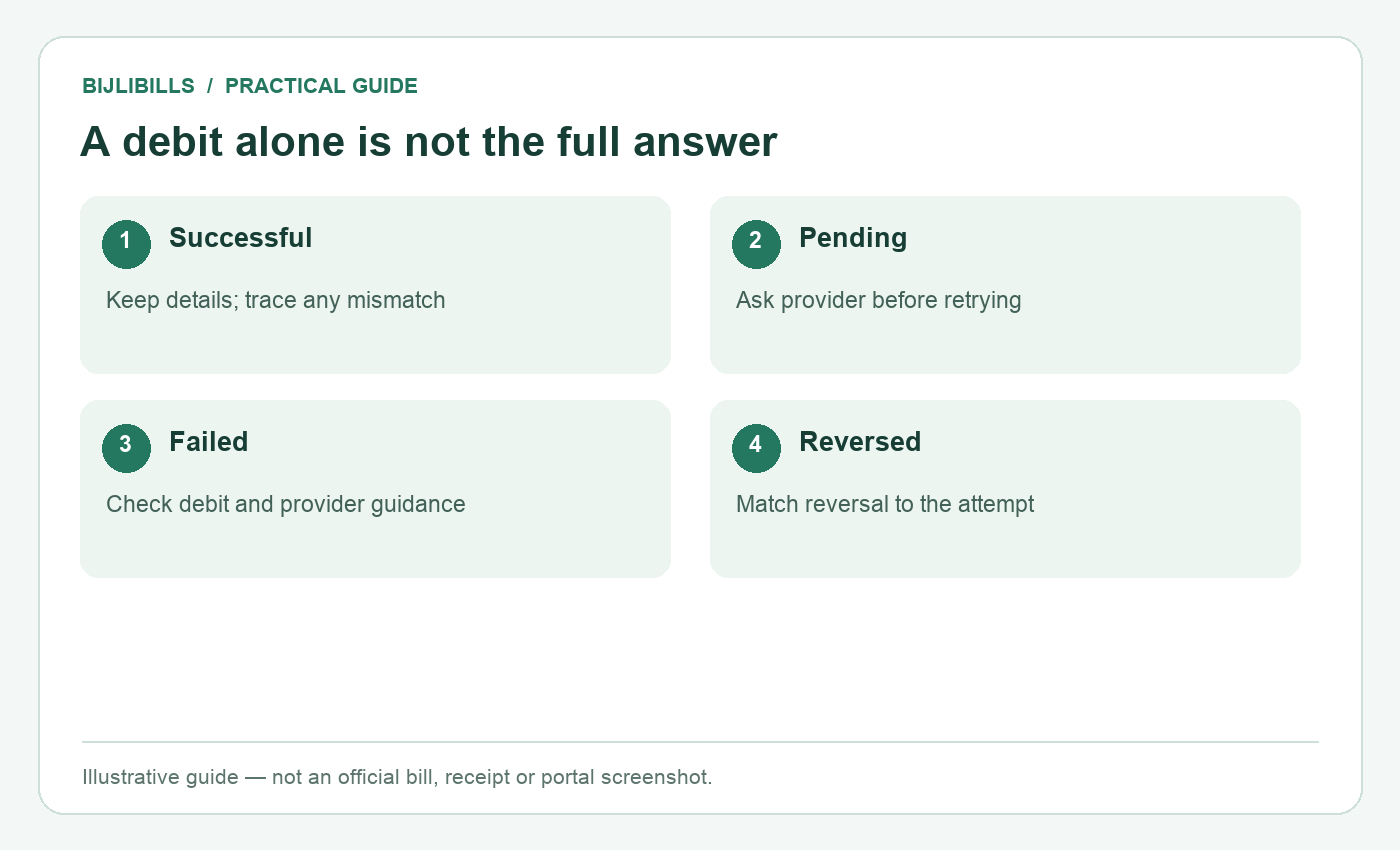
Illustrative workflow: a debit alone is not the full answer. This is not an official bill or portal screenshot.
Frequently asked questions
1. Does the bill still opening mean it is unpaid?
No. Availability of the document alone does not establish payment status. Check transaction evidence and any relevant utility record.
2. Is money deducted enough proof of success?
Not by itself. Find the associated transaction and its reported outcome, including any failure, pending state or reversal.
3. What is the strongest record to save from my provider?
Keep the detailed receipt showing biller, account reference, amount, date, status and transaction ID where available.
4. Can I check payment by looking at an old PDF?
An old PDF is a static record. It does not update after a payment made later.
5. What if my payment app says pending?
Follow that provider's instructions and establish the first attempt's state before making another payment.
6. What if the amount matches but the reference does not?
Treat it as a mismatch. The correct amount paid to another connection does not establish payment of your bill.
7. Should I pay again after a successful receipt?
Do not pay again solely because the bill remains visible. Investigate any actual unresolved balance using the receipt.
8. Can BijliBills mark a bill paid?
No. Only the relevant payment and utility systems control their records.
9. Does an SMS always contain enough detail?
Not necessarily. Retain the detailed transaction record and verify that the message is genuine and matches the payment.
10. What if the next bill includes an amount I already paid?
Collect both bills and the original payment evidence, then request a posting review from the appropriate provider and FESCO office.
11. Is there a universal 24-hour posting rule?
No such rule was verified for every FESCO payment channel here. Use the specific provider's current instructions.
12. Which identifier belongs in a payment complaint?
Keep both the electricity account reference and the transaction ID. They identify different records needed for tracing.
13. Can I redact a receipt before sharing it?
For informal household sharing, remove unnecessary financial details. Official support may require specific unredacted fields through its secure process.
14. What if another family member paid the bill?
Ask for the actual receipt and match the account and month. A verbal confirmation alone may leave useful details missing.
15. How should an unresolved payment be recorded?
Mark it as pending investigation, preserve the evidence and case number, and tell other payers to check before attempting another transaction.
Verify the transaction and preserve its trail
A reliable paid-status check connects the correct bill, a specific payment and the relevant account record. Read the actual transaction outcome, match the identifiers and keep the receipt. When those records disagree, request a trace instead of treating another payment as a test.