 Skip to content

Seeing money leave your bank or wallet while the electricity bill still looks unpaid is worrying, especially near the due date. Before sending another payment, separate three questions: did your account lose the money, what status did the provider give the transaction, and did the electricity company receive it against the correct reference? When money is deducted but the bill is unpaid, those records provide the route to a useful investigation.
Start by saving the transaction details and checking the provider’s status. Then ask the provider to trace the payment and, where necessary, ask your electricity company to reconcile it. The FESCO examples below explain the process without assuming that every bank, wallet or distribution company updates at the same speed.
Money deducted but bill unpaid: check the records
A deduction shows that your bank or wallet balance changed. By itself, it does not answer whether the biller accepted the payment, whether a reversal is pending, or whether the payment used the intended reference number.
Likewise, a duplicate electricity bill is not a live banking statement. Reopening an older PDF cannot show what happened to a later transaction. Use BijliBills to obtain a fresh bill where needed, then compare the bill month and account with your payment record.
Keep these pieces of evidence separate:
| Record | What to examine | What it cannot establish alone |
|---|---|---|
| Account transaction | Amount, date, debit and any reversal | Correct posting to the electricity account |
| Provider receipt | Biller, reference, transaction ID and status | The latest electricity-company ledger position |
| Current electricity record | Billing month, arrears and recorded payment | Whether a new provider investigation is complete |
| Complaint acknowledgement | Ticket number and issue reported | Successful correction of the account |
Official JazzCash bill-payment instructions include confirmation and receipt stages. The Easypaisa bill-payment guidance also distinguishes payment input and failure conditions. Neither source verified a universal FESCO ledger-posting deadline for this guide.
A seven-step payment tracing procedure
- Record the transaction once. Save the transaction ID, date, amount, selected biller, reference number and the status shown in the app. Preserve a readable receipt if available.
- Check for a reversal. Review the transaction details and your account record. Do not infer reversal merely because the bill still looks unpaid.
- Compare the reference digit by digit. Match it to the bill you intended to pay, including any leading zero. Confirm the company and billing month as well.
- Ask the payment provider for a trace. Explain whether its screen shows pending, failed or successful. Give the transaction ID through its official support channel and ask what happened at the biller stage.
- Obtain a support reference. Record the provider’s case number, instructions and next update point. A specific follow-up date is more useful than repeatedly reopening the app.
- Contact the electricity company when appropriate. If the provider confirms a successful payment to the correct biller, present that evidence and ask the company to reconcile the account.
- Check the outcome. Verify the corrected ledger or bill and any provider reversal. Close your record only when the money and bill have been accounted for.
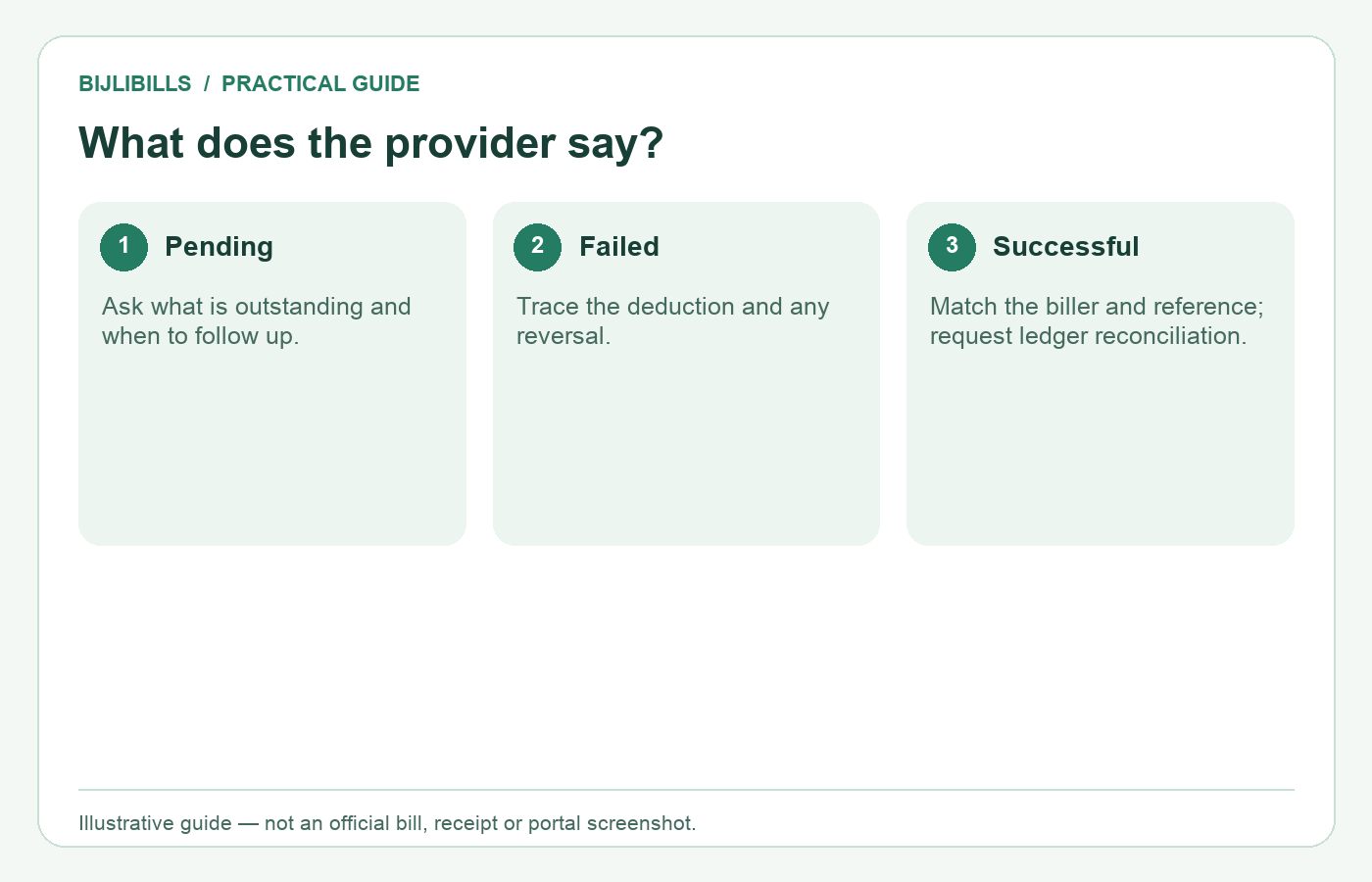
A troubleshooting diagram, not a promise about processing times or an example of an actual customer transaction.
Follow the branch that matches the provider’s status
The payment is pending
Ask whether the transaction is still processing, awaiting confirmation or under investigation. Keep enough money available for any legitimate payment decision, but avoid initiating a duplicate simply to make the screen change.
There is no verified universal “wait 24 hours” or “wait 48 hours” rule for every provider and FESCO account. Use the provider’s current guidance for your transaction. If the due date is approaching, tell both relevant parties rather than relying on a generic internet waiting period.
The payment failed but the money is missing
Ask the provider whether the deduction is temporary and whether a reversal has been initiated. Request the expected next update and the case number. A failed payment message does not by itself prove that the money is already back in the account.
Once the provider explains the status, confirm your available balance and the correct amount due before deciding how to pay. Do not treat an unsupported screenshot from someone else as proof of your reversal.
The provider says successful
Compare the reference, company, amount and transaction time with the bill. If everything matches, ask the provider for confirmation suitable for a biller investigation. Send that with your current bill to the appropriate electricity-company channel.
If the reference does not match, report the wrong-account payment promptly. Our wrong-reference electricity payment guide explains the evidence to preserve. Do not assume another consumer’s credit can be instantly moved or refunded.
When a paid FESCO amount appears as arrears
First compare the month being carried forward with the month you paid. A successful payment against a different connection or a different amount does not resolve the apparent mismatch.
Section 10.3.1(i) of the NEPRA Consumer Service Manual, revised 26 November 2025 specifically addresses a previously paid amount appearing in a subsequent bill and correction by competent officers against the original previous paid bill. This supports presenting the payment evidence for review; it is not a guarantee that an app screenshot alone proves ledger posting.
For FESCO, describe the disputed amount precisely: “The September bill was paid on this date against this reference. The October bill carries this amount as arrears.” Attach the relevant records privately. Our electricity bill paid-status guide helps distinguish the different records.
Build a small evidence packet
Keep a current bill, the bill you paid, the provider receipt, the account deduction or reversal record, and a short contact log. Preserve originals. If you send copies, avoid hiding the fields the authorized investigator needs, while removing unrelated transactions and balances.
An illustrative log could contain: payment attempted on Monday; provider displayed successful; case opened Tuesday; receipt sent to the subdivision Wednesday. These are example labels, not a suggested mandatory timeline. Record the actual dates and the person or channel that gave each response.
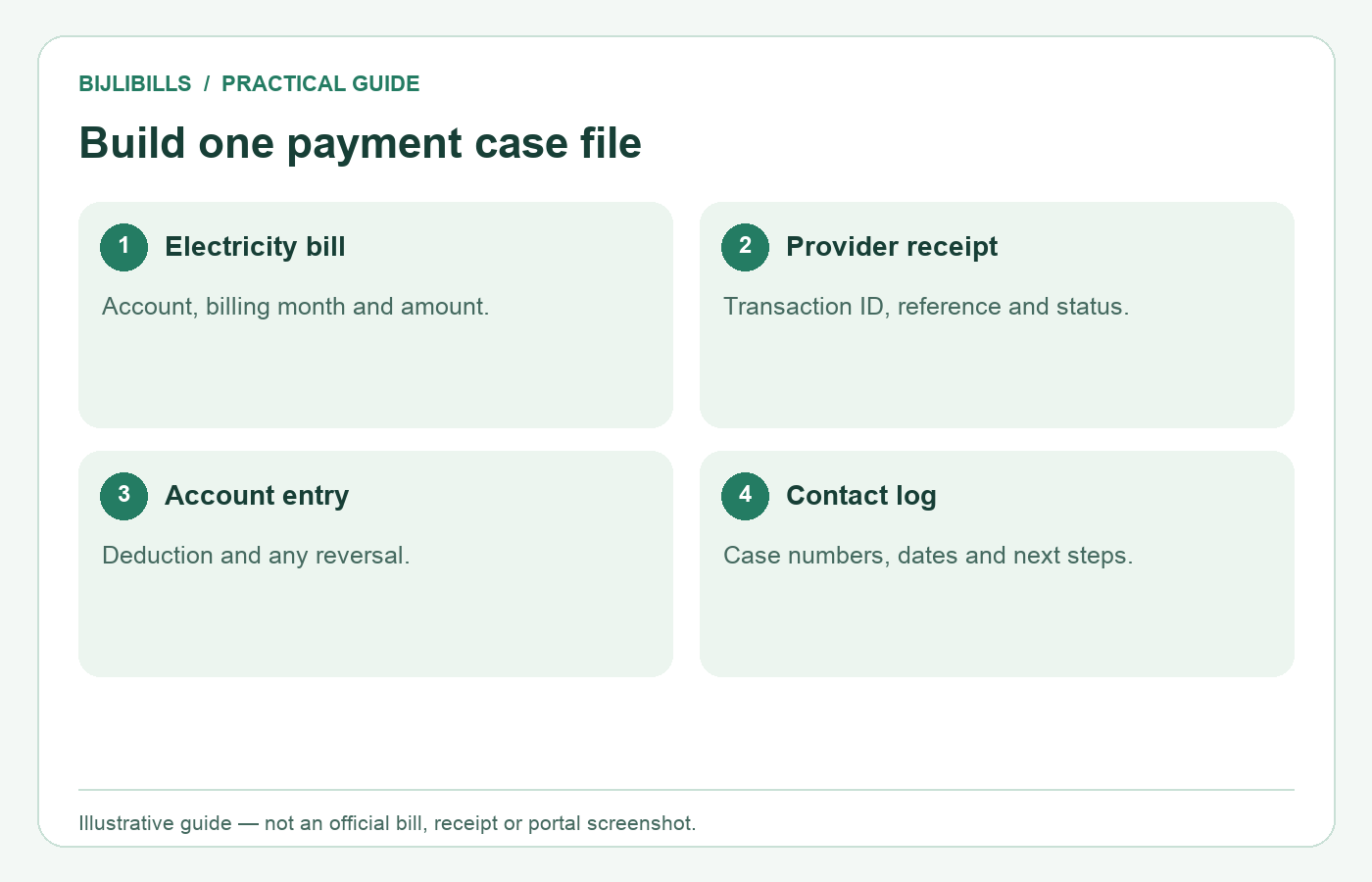
Keep these records together so each support request refers to the same transaction.
Due dates and complaint escalation
An unresolved payment complaint is not automatically an approved due-date extension. Ask what amount, if any, must be paid while the investigation continues, and request written clarification. Our guide to payment after the due date explains why the bill’s current payable amount matters.
For a FESCO billing-side complaint, the PITC complaint form provides a route to record the issue. Keep the acknowledgement and follow up against the same case. A provider case and a FESCO case may both be needed because they investigate different records.
Frequently asked questions
What if I have no receipt but can see a debit?
Ask the provider to retrieve the transaction using its recorded date, amount and account details. Do not invent a transaction ID or use another payment’s receipt.
Can I rely on a forwarded success SMS?
Verify it against the payer’s actual transaction history. A forwarded message may belong to another amount, reference or connection.
What if a relative paid the bill for me?
Ask that relative for the complete provider receipt and status. The account holder may need to contact the provider through their own authenticated channel.
Should I share my wallet PIN with FESCO support?
No. A transaction investigation needs payment evidence, not your banking PIN, login password or authorization OTP.
Does a bank holiday prove the payment is delayed?
No. Ask the provider about your transaction rather than assuming a cause based on the calendar.
Can a payment be successful for the wrong company?
The selected biller matters. Show the provider exactly which company appears on the receipt and ask it to investigate any mismatch.
What if my receipt shows an incomplete reference?
Ask the provider for the underlying biller reference or a fuller transaction record. Avoid guessing the missing digits.
Will opening several complaints speed up a trace?
It may make the record harder to follow. Use the existing case number unless support specifically asks for a new complaint.
Can I edit a receipt to add a missing detail?
Keep the original intact. Put explanatory notes in a separate message and ask the provider to correct or clarify its own record.
What if the money returns after I paid through another channel?
Reconcile both transactions and the bill. Confirm which payment reached the biller and retain the reversal record for the unsuccessful attempt.
Can an agent’s handwritten note replace a receipt?
Ask for the authorized transaction record with its reference and status. A note may help explain events but does not establish electronic posting.
What should I ask when support says “resolved”?
Ask what changed: payment delivered, credit posted, or money reversed. Check that outcome in the relevant record.
Does an unchanged bill total always mean payment failed?
No. You may be viewing a billing document rather than a current payment ledger. Confirm the source and the bill month.
Can the checker website refund my payment?
BijliBills does not collect electricity payments. Contact the actual bank, wallet or authorized payment channel that handled the transaction.
When can I stop keeping the evidence?
Keep it until the payment and any later arrears are reconciled. Retain it with your household records according to your own needs.
Resolve the transaction, not just the screen message
The useful outcome is a traceable payment or a confirmed reversal, matched to the correct electricity account. Save the evidence, follow the provider’s actual status, and verify FESCO’s record where needed before assuming a second payment is the solution.