 Skip to content
FPA in an electricity bill can be puzzling when you reduced this month's usage but still see an extra charge. The complication is that a fuel adjustment may concern an earlier consumption month. Which units and rate should you check? Find the adjustment's named month, locate the final official notification, and compare its applicable rate and category with the corresponding bill record.
This guide uses a verified, dated FESCO example to explain the process. It does not label an older adjustment as the current rate for every bill. Open your statement through the BijliBills electricity checker and keep the earlier month's record nearby.
What FPA in an electricity bill means
FPA stands for Fuel Price Adjustment; official NEPRA documents also use Fuel Charges Adjustment, or FCA. It is a separately identified adjustment arising through the notified fuel-cost mechanism. It is not the whole electricity tariff and should not be confused with a quarterly adjustment.
The NEPRA Consumer Service Manual, revised 26 November 2025, lists FPA and QTA among separate bill components in section 6.4.1. Reading them as different lines helps explain why the final payable total cannot be calculated from current units alone.
An adjustment may be positive or negative under its particular notification. A positive figure is not automatically a mistake, and a negative rate does not mean every category receives an identical refund without conditions.
The three dates you need to separate
A fuel adjustment involves at least three useful dates or periods: the month whose fuel costs are being considered, the notification date, and the billing month in which the adjustment is applied.
FESCO's official FPA archive presents separate billing-month and FPA-month columns. That structure is a warning against multiplying an adjustment by whichever unit number is most convenient.
For example, the archive viewed on 12 October 2026 had its latest visible row for August 2026 billing and June 2026 FPA. That does not establish the applicable fuel adjustment on an October statement. If an archive is behind, use the relevant final notification and the bill's own adjustment description.
A verified example: July 2026 FCA
NEPRA's notification dated 4 September 2026, SRO 1499(I)/2026, approved a positive Rs 2.0581 per kWh FCA for July 2026. It directed ordinary application in September 2026 bills using units billed for July 2026, with subsequent application allowed where September bills had already been issued before notification. Final notification, PDF page 14.
That notification excludes lifeline consumers, electric-vehicle charging stations, and consumers who opted for prepaid tariffs. It includes consumption under the incremental consumption package and requires compliance with applicable court orders.
These details matter as much as the number. This example must not be described as an unconditional “October FESCO FPA rate” or applied to every connection without reading the category rules.
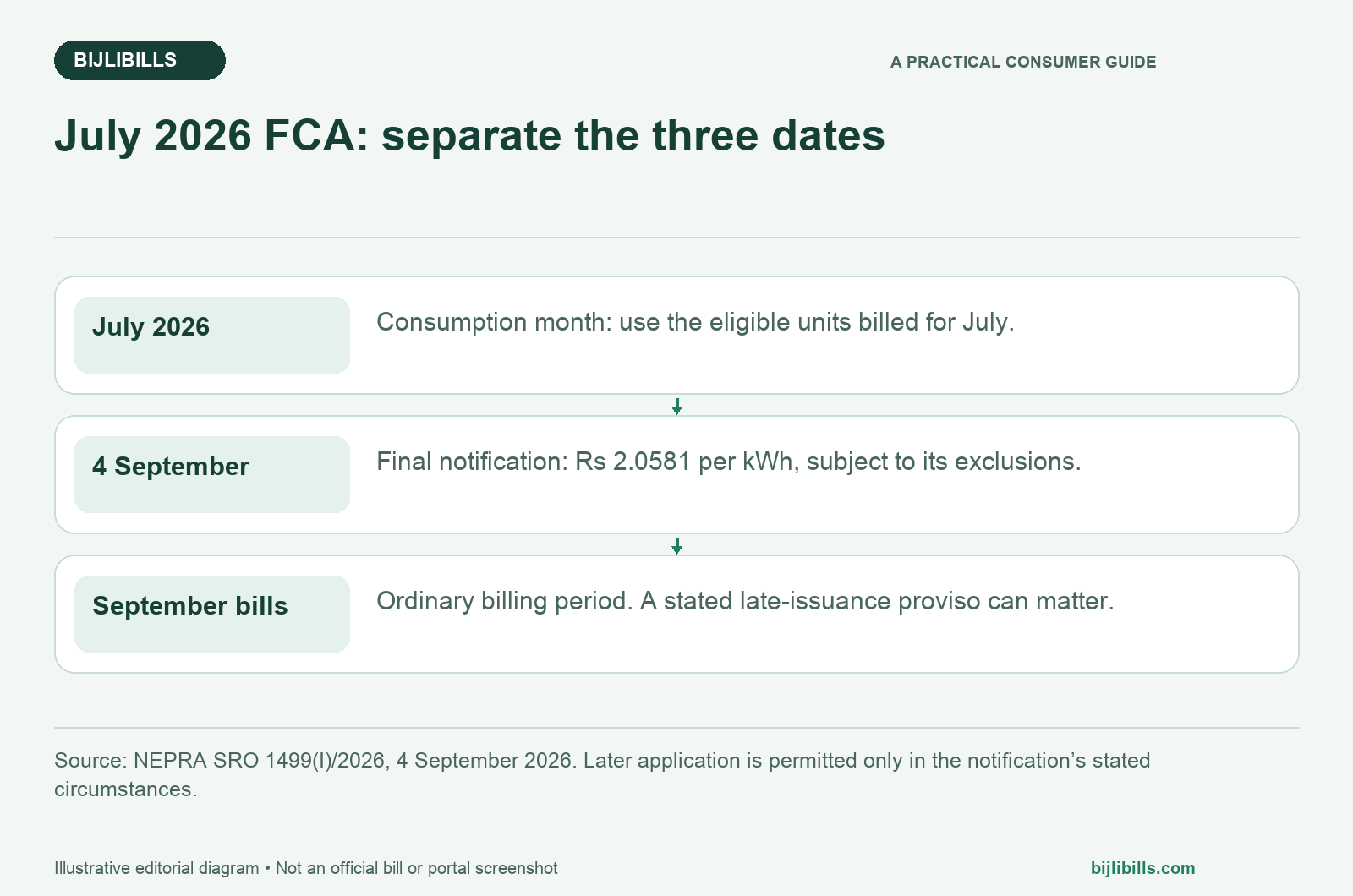
Source: NEPRA SRO 1499(I)/2026, 4 September 2026. Later application is permitted only in the notification’s stated circumstances.
Worked calculation with the correct consumption period
Suppose an eligible illustrative account had 250 billed units in July 2026. Applying the cited final adjustment gives:
250 × Rs 2.0581 = Rs 514.525, or approximately Rs 514.53 before any separate tax or rounding treatment that applies to the real account.
If the account used 180 units in September, multiplying 180 by the July adjustment would answer the wrong question. The notification specifies the earlier units. This example demonstrates that timing distinction; it does not calculate a complete electricity bill.
| Item to verify | Example value | Why it matters |
|---|---|---|
| Consumption month | July 2026 | Identifies the relevant historical units |
| Billed units used | 250, illustrative | Determines the multiplication basis |
| Final approved FCA | Rs 2.0581/kWh | Avoids confusing a request with approval |
| Ordinary billing month | September 2026 | Explains the later appearance |
| Eligibility | Must match the notification | Prevents applying a charge to an excluded category |
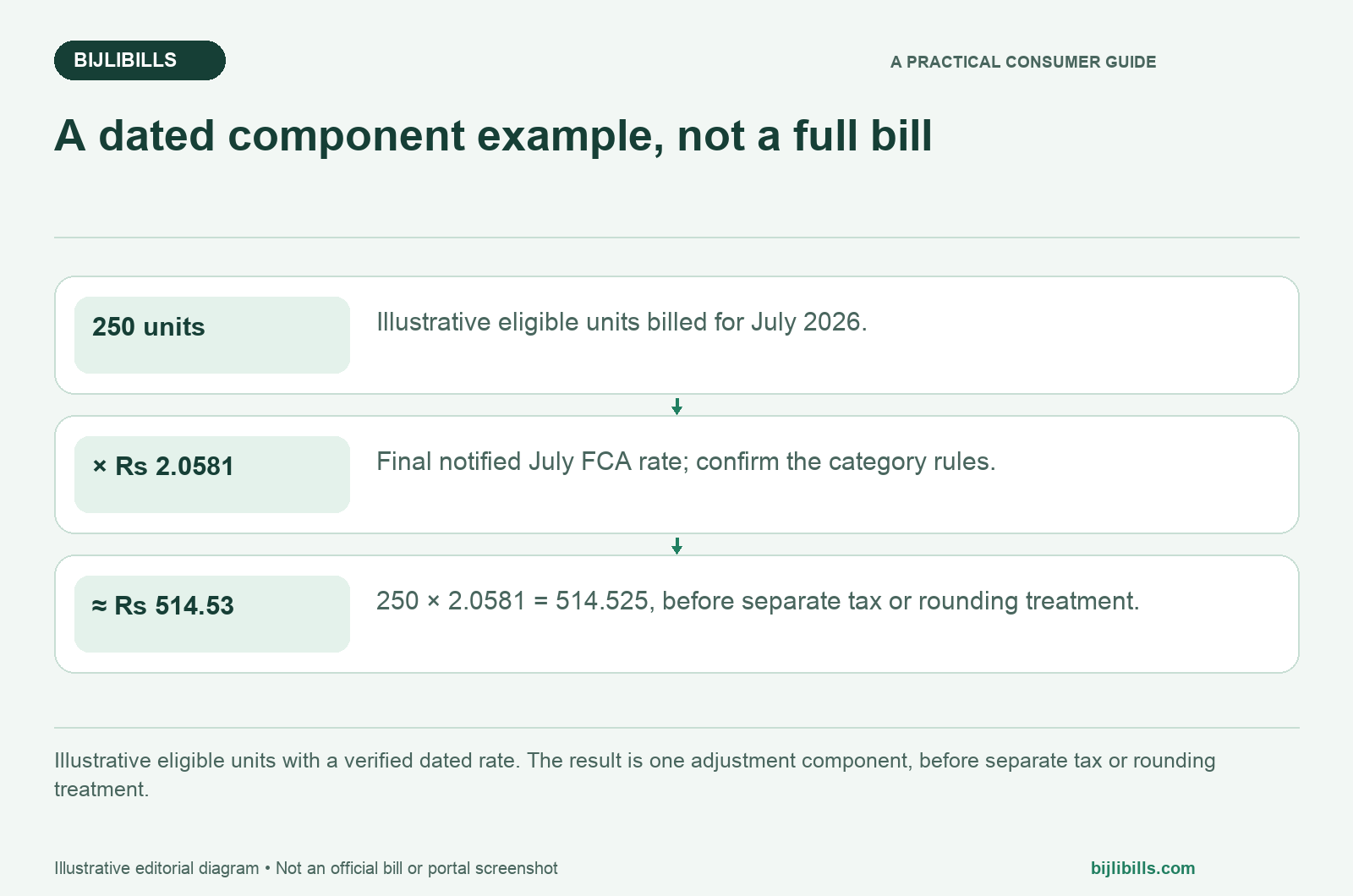
Illustrative eligible units with a verified dated rate. The result is one adjustment component, before separate tax or rounding treatment.
Step-by-step SOP for checking an FPA line
- Read the line exactly. Record its label, month and amount, including whether it is a debit or credit.
- Find the matching notification. Look for the final order, not a hearing notice or proposed request.
- Confirm the applicable company and category. Read exclusions and any special treatment.
- Locate the correct historical units. Use the consumption period stated in the order.
- Check for a corrected bill. Retain formal revisions if the earlier month's units changed.
- Multiply units by the approved rate. Keep enough decimal precision before final rounding.
- Separate linked taxes or other items. Do not assume the adjustment line explains every difference in the payable total.
- Check the recovery period. A later appearance may be permitted under a specific carry-forward condition, but it needs the relevant explanation.
- Ask about a precise mismatch. State the period, units, category and calculation you believe needs correction.
Use the electricity bill history guide if you need help finding the earlier statement or arranging a month-by-month record.
Do not confuse the requested rate with the final rate
A tariff document can contain several numbers describing different stages. The July 2026 decision begins with a requested adjustment of Rs 2.5182/kWh, but the final notified amount is Rs 2.0581/kWh.
Copying the first prominent figure would therefore overstate the approved adjustment. Read the operative order and notification, including exclusions and the billing period, before using a number in a calculation.
Similarly, a news report about a hearing is not proof that a requested change has taken effect. Save the final official document with your worksheet so another person can repeat the check.
When a negative adjustment or repeated line looks unusual
First check the sign and the account's actual total. A minus sign, a credit label or an adjustment reversal should be interpreted with the bill layout; do not add a credit as though it were another debit.
If a similar adjustment appears again, compare the named months and historical units. Two adjustments may concern different periods. If they appear to cover the same period twice, prepare both bills and ask for reconciliation rather than assuming that repeated wording alone proves double charging.
A changed meter or an officially corrected historical reading can also make the underlying record less obvious. Ask FESCO which units were used. Do not replace the figure with a private estimate without explaining the difference.
Prepare an FPA inquiry that can be checked
Include the reference number privately, current bill, relevant earlier bill, final notification and a short calculation. State whether your concern is eligibility, the rate, the historical units, a repeated adjustment or its timing.
The bill correction guide helps organise supporting evidence. For the wider distinction between tariff and bill total, use the electricity per-unit price guide.
A dispute does not itself establish a new payment deadline. Ask for written instructions about the payable amount and any approved extension while the matter is reviewed.
Frequently asked questions
1. Are FPA and FCA completely different charges?
Both labels are used in fuel-adjustment discussions. Read the exact bill line and official notification rather than relying on the abbreviation alone.
2. Is FPA the same as the base unit rate?
No. It is a separately identified adjustment. The underlying energy tariff and other applicable components still need their own checks.
3. Why can FPA appear after the consumption month?
The adjustment is determined and notified separately. The order states which consumption period and billing period should be used.
4. Can this month's lower units reduce an earlier adjustment?
Not automatically. If the order uses earlier billed units, current consumption is not the multiplication basis for that adjustment.
5. Does every customer pay every positive FPA?
No. Read the notification's categories, exclusions and any applicable legal directions before deciding whether it belongs on a particular bill.
6. Are protected consumers always exempt?
Do not assume a permanent exemption from the status label. The particular notification determines its applicable categories and exceptions.
7. Is a negative FPA always cash paid to me?
No. Check how the credit is reflected in the bill and the applicable order. Do not assume a separate cash refund.
8. Where should I find units for an older adjustment?
Use the statement or official record for the period named in the notification, including any formal correction affecting those units.
9. Can a proposed rate be used in a published calculator?
Only if clearly labelled a proposal, not an applicable bill charge. A payable estimate needs the final relevant notification.
10. Why might an adjustment appear one month later than expected?
Some orders allow subsequent application in stated circumstances. Ask which provision explains the particular account's timing.
11. Does an FPA calculation include all taxes?
Not by itself. Any related tax treatment needs its own applicable basis; the simple units-times-rate example is not a complete bill.
12. What if the historical bill was corrected?
Keep the corrected record and ask whether the adjustment used the revised eligible units rather than the superseded amount.
13. Should I compare FPA with my neighbour's amount?
Compare the period, eligible units and category first. Different amounts alone do not demonstrate inconsistent charging.
14. What if an archive has no entry for my bill month?
Look for the relevant final NEPRA notification and ask FESCO for the basis. Do not reuse the archive's last rate automatically.
15. Does paying a disputed adjustment prevent me keeping evidence?
Keep all bills, receipts and complaint records regardless. Ask the responsible forum about your specific dispute rather than discarding the documents.
Match the month before judging the amount
The quickest useful FPA check is to match the final rate, eligible category and correct historical units. Once those three agree, you can separate a legitimate later adjustment from a calculation or account-record issue that needs review.