Electricity Per Unit Price in Pakistan: Slab Rates, Taxes and Real Bill Examples (August 2026)

Updated: August 2026

The electricity per unit price in Pakistan, as of August 2026, runs from Rs 3.95 per unit for lifeline consumers to Rs 47.20 per unit for homes using more than 700 units a month. These slab rates were reset by SRO 279(I)/2026, which took effect on 12 February 2026. It did two things at once: it cut the rates for every slab above 300 units by roughly Rs 1.5 per unit, and it added a new monthly fixed charge billed per kilowatt of your sanctioned load. So the headline unit rate fell for heavy users, while the new fixed charge claws much of that saving back on the total bill. A NEPRA review petition against the fixed charges is pending (filed March 2026), and a further government tariff package was under discussion in late July 2026, so these figures can move again.

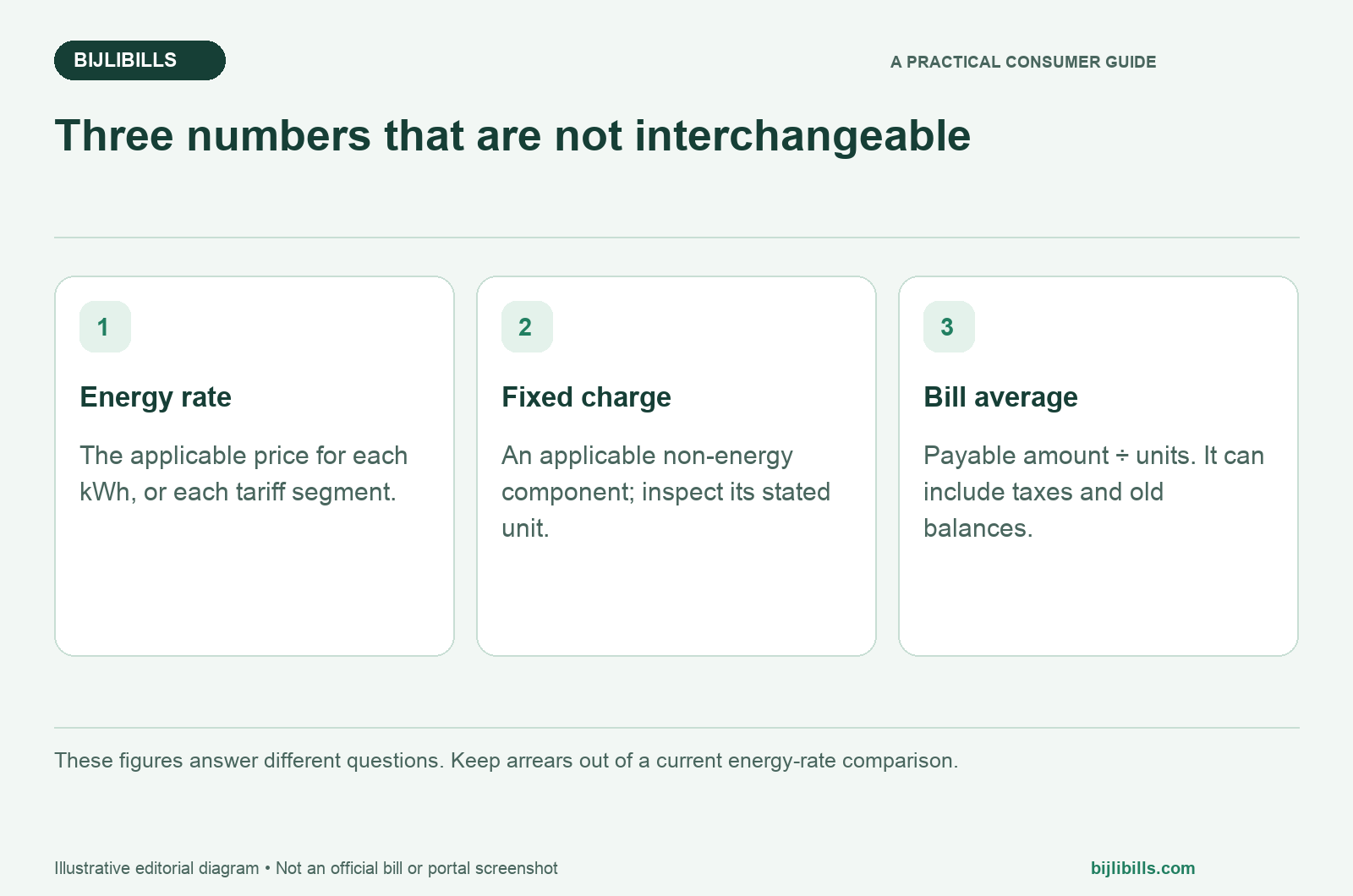
That is the energy price only. Your bill stacks more on top: the new per-kW fixed charge, a Rs 3.23 financing cost surcharge, 18% GST and provincial electricity duty, plus fuel and quarterly adjustments that move every month. Surcharge, duty and GST alone lift a 300-unit household from a base slab rate of Rs 33.10 to about Rs 43.5 per unit, before the fixed charge and the monthly adjustments are layered on.

This guide gives you the full slab table, the new fixed charges, protected vs unprotected rates side by side, worked bills for 100, 200, 300 and 500 units, and links to detailed rate pages for all 11 power companies in Pakistan.

Current Electricity Per Unit Prices in Pakistan (August 2026)

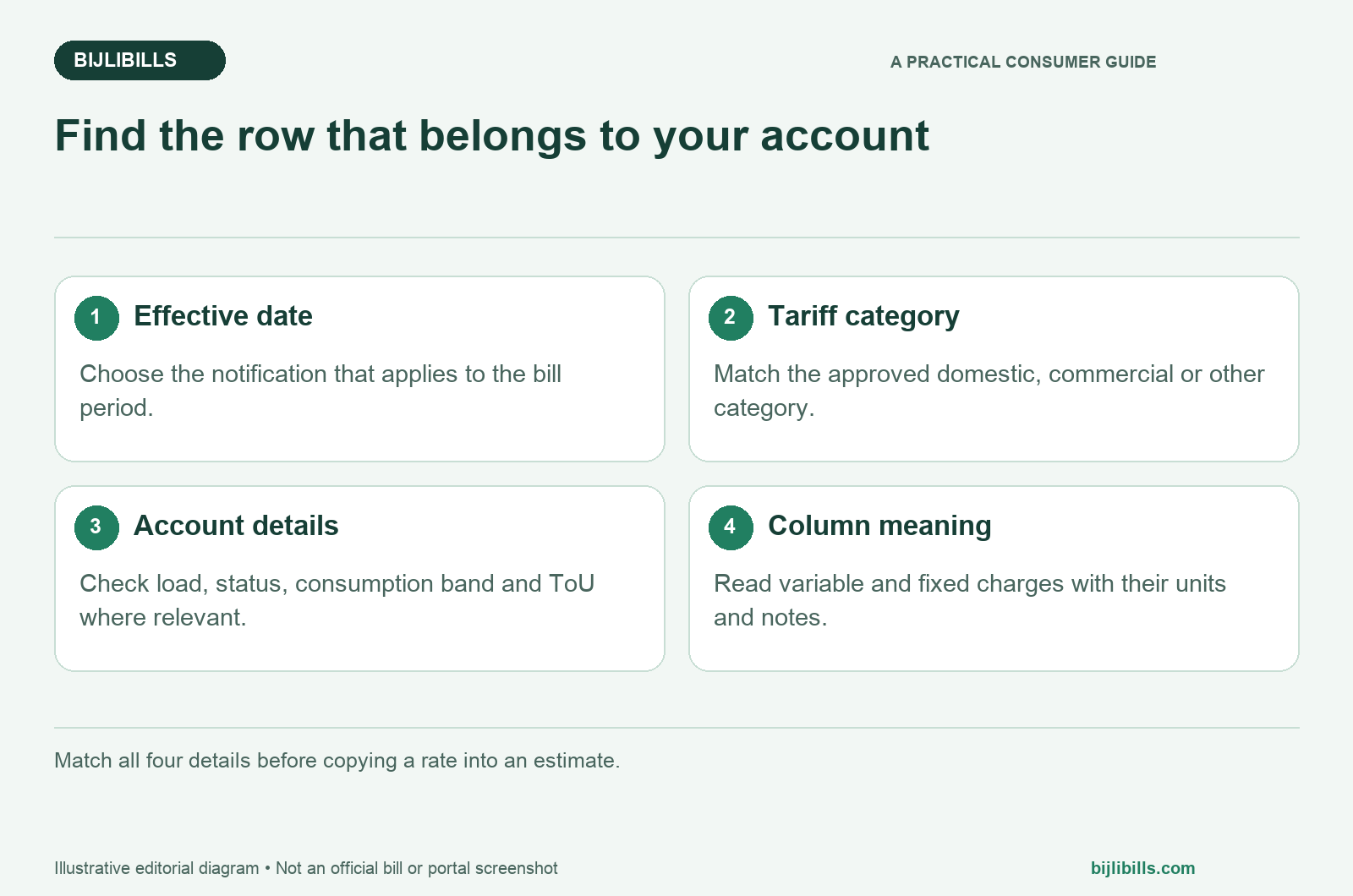
Every distribution company in Pakistan bills domestic consumers on the same uniform slab schedule. The rates below took effect on 12 February 2026 under SRO 279(I)/2026. The 1–100, 101–200 and 201–300 slabs carried over unchanged from the July 2025 schedule; every slab above 300 units was cut by about Rs 1.5 per unit, and a separate per-kW fixed charge was introduced at the same time.

Monthly consumption Protected rate (Rs/unit) Unprotected rate (Rs/unit)
Up to 50 units (lifeline) 3.95
51–100 units (lifeline) 7.74
1–100 units 10.54 22.44
101–200 units 13.01 28.91
201–300 units 33.10
301–400 units 36.46
401–500 units 38.95
501–600 units 40.22
601–700 units 41.85
Above 700 units 47.20

Source: uniform domestic tariff schedule under SRO 279(I)/2026, effective 12 February 2026, as published on the official DISCO tariff pages (IESCO, FESCO). Rates shown as of August 2026.

How the slabs are actually applied

This is where most people, and most rate websites, get it wrong.

Since NEPRA’s subsidy re-targeting decision of March 2022, unprotected domestic consumers get no previous-slab benefit. Your whole month’s consumption is billed at the rate of the slab your total lands in. Use 300 units and all 300 are charged at Rs 33.10. Use 301 and all 301 are charged at Rs 36.46. That single extra unit adds just over Rs 1,040 to your energy charge before tax.

Protected consumers get the benefit of one previous slab. A protected home using 180 units pays the first 100 at Rs 10.54 and the next 80 at Rs 13.01.

Lifeline consumers get no slab benefit either, but they don’t need one: their single low rate applies to everything, and they are exempt from the financing cost surcharge and monthly fuel adjustments.

These rules come straight from NEPRA’s TRF-100 policy guideline determination, which is why a bill can double when consumption creeps up by a handful of units.

Why you see three different “average tariff” figures online

Search for electricity rates in Pakistan 2026 and you will find Rs 31.59, Rs 33.38 and “around Rs 31” quoted as the average tariff, sometimes on the same website. Here is what each number actually is:

  • Rs 31.59 per unit — the national average consumer-end base tariff set on 1 July 2025. It is the figure most third-party sites still quote, but it predates SRO 279 and no longer captures the February 2026 cut to the 301+ slabs or the new per-kW fixed charges.
  • Rs 33.38 per unit — NEPRA’s determined cost-recovery average for calendar year 2026, set in January 2026. It is Rs 0.62 lower than the previous determination of Rs 34.00. The consumer-end schedule that followed, SRO 279 of 12 February 2026, then trimmed the upper slabs and shifted part of the recovery onto fixed charges instead of per-unit energy rates.
  • “Around Rs 31” — rounded versions of the first figure. Treat any single “average” figure with caution: since February 2026 your effective rate depends on your slab, your sanctioned load and the fixed charge, not one headline number.

One more wrinkle: the rebasing calendar itself has moved. Base tariffs used to reset every 1 July with the fiscal year. NEPRA now determines them on a calendar-year cycle — SRO 279 was the February 2026 consumer-end notification — and the next full rebasing is committed for 15 January 2027 under the IMF programme.

Fixed Charges: The New Per-kW Line on Every Bill

The change most people miss in SRO 279 is not the small cut to the upper unit rates — it is a monthly fixed charge that most domestic consumers had never seen before. Unlike the energy charge, it has nothing to do with how many units you burn. It is based on your sanctioned load, the kilowatts your connection is approved for, and it is billed even in a month you use nothing at all. GST applies on top of it.

The rate per kilowatt is set by the slab your consumption lands in that month, then multiplied by your full sanctioned load. A 2 kW home pays twice the table rate, a 3 kW home three times.

Consumption slab (units/month) Protected (Rs per kW) Unprotected (Rs per kW)
1–100 200 275
101–200 300 300
201–300 350
301–400 400
401–500 500
501 units and above 675

Worked example: a 2 kW single-phase home that uses 300 units lands in the 201–300 slab, so its fixed charge is 2 × Rs 350 = Rs 700 for the month before GST, on top of the energy charge. A 3 kW home drawing 500 units pays 3 × Rs 500 = Rs 1,500.

Two special cases:

  • Time-of-use consumers (5 kW and above) pay Rs 675 per kW, but applied to whichever is larger — 50% of sanctioned load or the recorded maximum demand (MDI) — rather than the full sanctioned load.
  • Lifeline consumers pay no fixed charge. In its place they face a minimum charge of Rs 75 (single-phase) or Rs 150 (three-phase); only one of the two ever applies, and in practice only lifeline homes see it.

The fixed charge is exactly what the NEPRA review petition filed in March 2026 is contesting, so this line could be revised or withdrawn on a future schedule.

Protected vs Unprotected: Which Rate Applies to You

Protected status moves your per unit price more than any other single thing on the bill, your DISCO and city included.

You are protected if you are a non-TOU domestic consumer and your consumption has stayed at 200 units or below for six consecutive months. Cross 200 units even once and you lose the status: that month is billed at unprotected rates, and you then need six straight months at or under 200 units to win protection back.

The money at stake is large. At 200 units, a protected consumer’s energy charge is Rs 2,355. At 201 units, an unprotected consumer’s energy charge is Rs 6,653 — all 201 units at Rs 33.10, with no slab benefit. After surcharge and taxes, the difference between those two bills is roughly Rs 5,150. One unit.

We’ve written a full breakdown of the six-month rule, the tracking method DISCOs use and how to protect your status in our guide to protected vs unprotected electricity consumers.

What You Actually Pay Per Unit: The Full Cost Stack

The slab rate is only the first line of your bill. Here is everything that sits on top of it in August 2026:

  • Fixed charge. The per-kW-of-sanctioned-load line introduced by SRO 279 in February 2026, set by your consumption slab (see the fixed-charge table above). It is billed even at zero consumption and attracts GST. Lifeline consumers are exempt.
  • Fuel price adjustment (FPA/FCA). A monthly plus-or-minus correction for the actual cost of fuel two months earlier. NEPRA approved a positive adjustment of Rs 0.3364 per unit for May 2026, charged in July bills. Lifeline, prepaid and EV-charging consumers are exempt. Full mechanics in our guide to FPA in your electricity bill.
  • Quarterly tariff adjustment (QTA). Currently working in your favour: for the January–March 2026 quarter, NEPRA allowed a negative adjustment of Rs 1.9857 per unit in June, July and August 2026 bills, a combined relief of about Rs 67 billion.
  • Financing cost surcharge. Rs 3.23 per unit on every slab except lifeline, earmarked for repaying power-sector debt. It appears on bills as “FC SUR”; news reports also call it the debt service surcharge.
  • Electricity duty. A provincial levy, typically around 1.5% of your variable charges.
  • GST. 18% sales tax on the bill, per FBR rules.
  • TV licence fee — no longer charged. The flat Rs 35 PTV fee was taken off electricity bills in July 2025. If a current bill still shows it, query the line with your DISCO.
  • Advance income tax. Domestic bills above Rs 25,000 a month attract 7.5% advance tax if you are not on the Active Taxpayer List.

The result: a base rate of Rs 33.10 becomes an effective Rs 43–44 per unit for a typical 300-unit household. Line-by-line detail, with who is exempt from what, is in our guide to taxes on your electricity bill.

Adjustments currently in force

Adjustment Amount (Rs/unit) Applies in Status
QTA (Jan–Mar 2026 true-up) −1.9857 Jun, Jul, Aug 2026 bills Notified
FPA for May 2026 +0.3364 Jul 2026 bills Notified
FPA for June 2026 +1.20 (requested) Aug 2026 bills Heard 29 Jul, awaiting decision

The June FPA petition, if approved as filed, would recover about Rs 15.7 billion from DISCO and K-Electric consumers in August bills.

Worked Examples: What 100, 200, 300 and 500 Units Cost

All four examples assume a single-phase domestic connection on a WAPDA-successor DISCO, using the August 2026 base schedule, the Rs 3.23 financing cost surcharge, 1.5% electricity duty on the energy charge and 18% GST. The new per-kW fixed charge is left out here so the energy-driven totals stay comparable — add it from the fixed-charge table above for your own sanctioned load (for a 2 kW home the amounts are small next to the energy charge). Monthly FPA and QTA are also excluded and shown separately below, because they change every month.

100 units (protected): energy charge 100 × 10.54 = Rs 1,054. Surcharge Rs 323. Duty Rs 15.81. GST at 18% on Rs 1,392.81 = Rs 250.71. Total ≈ Rs 1,644.

200 units (protected): energy charge (100 × 10.54) + (100 × 13.01) = Rs 2,355. Surcharge Rs 646. Duty Rs 35.33. GST on Rs 3,036.33 = Rs 546.54. Total ≈ Rs 3,583.

300 units (unprotected): energy charge 300 × 33.10 = Rs 9,930 (no slab benefit). Surcharge Rs 969. Duty Rs 148.95. GST on Rs 11,047.95 = Rs 1,988.63. Total ≈ Rs 13,037.

500 units (unprotected): energy charge 500 × 38.95 = Rs 19,475. Surcharge Rs 1,615. Duty Rs 292.13. GST on Rs 21,382.13 = Rs 3,848.78. Total ≈ Rs 25,231. Even after the SRO 279 cut this bill still crosses the Rs 25,000 line, so add 7.5% advance income tax if you are not an active tax filer.

Units used Status Energy charge Total bill (approx.) Effective Rs/unit
100 Protected Rs 1,054 Rs 1,644 16.4
200 Protected Rs 2,355 Rs 3,583 17.9
300 Unprotected Rs 9,930 Rs 13,037 43.5
500 Unprotected Rs 19,475 Rs 25,231 50.5

Now add the monthly adjustments. In July 2026 bills, the net of QTA (−1.9857) and FPA (+0.3364) was −1.6493 per unit. For the 300-unit example that is a reduction of Rs 494.79 before tax, or roughly Rs 585 including the GST effect, bringing the bill down to about Rs 12,490. In August, the pending June FPA could swing the net the other way.

Notice the cliff between 200 and 300 units: consumption grows 50% but the bill grows 260%. That cliff, not the base tariff, is why so many bills “suddenly” double in summer.

Time-of-Use (TOU) Rates: Peak and Off-Peak Pricing

If your sanctioned load is 5 kW or more, your DISCO bills you on a time-of-use meter with two registers instead of slabs: a peak rate and an off-peak rate.

As of August 2026, SRO 279 sets the domestic TOU peak rate at Rs 46.85 per unit and the off-peak rate at Rs 34.53 per unit, before monthly adjustments. The off-peak rate fell by about Rs 5.5 under this schedule, widening the peak-to-off-peak gap to more than Rs 12 per unit and making it far more worthwhile than before to shift heavy loads out of peak hours. TOU consumers also carry the new fixed charge, levied at Rs 675 per kW on whichever is larger, 50% of sanctioned load or recorded maximum demand (MDI). NEPRA revises the paisa figures with each notification, and both registers are printed on your bill, so check the “Peak” and “Off-Peak” lines for the rates applied to your connection.

The peak window is only four hours a day. Most DISCOs place it between 5:00 pm and 11:00 pm, shifting with the season: later in summer, earlier in winter. Running heavy loads (washing machine, iron, water pump) outside that window is the cheapest saving available to TOU consumers because it needs no hardware at all. City-wise timings for every company are in our guide to electricity peak hours in Pakistan.

K-Electric vs WAPDA DISCOs: Is Karachi Different?

Short answer: the base rates are identical; the plumbing behind them is not.

K-Electric is a privately owned, vertically integrated utility serving Karachi and its suburbs, with its own multi-year tariff determined by NEPRA for FY2023-24 through FY2029-30. But under paragraph 5.6.3 of the National Electricity Policy 2021, KE consumers are not charged KE’s determined tariff. NEPRA’s notification of the KE supply tariff decision is explicit: K-Electric consumers are to be charged the uniform tariff applicable to ex-WAPDA DISCO consumers. The federal subsidy covers the gap.

So a 300-unit home in Karachi sees the same Rs 33.10 base rate as one in Lahore. The differences you will notice are at the margins: fuel adjustments for KE are determined on KE’s own generation mix (though NEPRA now routinely notifies DISCO and KE adjustments together), Sindh’s electricity duty rules apply, and KE runs its own billing and complaint systems.

One habit worth dropping: calling the rest of the country “WAPDA rates”. WAPDA stopped billing households years ago; it now runs water and hydel projects. Distribution went to the ten ex-WAPDA DISCOs (LESCO, MEPCO, FESCO and the rest). When people search for the WAPDA per unit price, the number they want is the uniform DISCO tariff in the table above.

Per Unit Price by DISCO: All 11 Companies Compared

Because of the uniform tariff, the base slab rates below are the same for every company. What differs is service territory, reliability, FPA timing and how you check your bill. Each link goes to that company’s dedicated rate guide with worked examples for its consumers.

Company Areas served Base slab rates Detailed rate guide
LESCO Lahore, Kasur, Sheikhupura, Okara, Nankana Sahib Uniform schedule LESCO per unit price
MEPCO Multan, Bahawalpur, DG Khan, Sahiwal and south Punjab Uniform schedule MEPCO per unit price
FESCO Faisalabad, Jhang, Sargodha, Mianwali, Chiniot Uniform schedule FESCO per unit price
IESCO Islamabad, Rawalpindi, Attock, Jhelum, Chakwal Uniform schedule IESCO per unit price
GEPCO Gujranwala, Gujrat, Sialkot, Narowal, Hafizabad Uniform schedule GEPCO per unit price
PESCO Peshawar and most of Khyber Pakhtunkhwa Uniform schedule PESCO per unit price
HESCO Hyderabad and southern Sindh (outside Karachi) Uniform schedule HESCO per unit price
SEPCO Sukkur and northern Sindh Uniform schedule SEPCO per unit price
QESCO Quetta and most of Balochistan Uniform schedule QESCO per unit price
TESCO Tribal districts of Khyber Pakhtunkhwa Uniform schedule TESCO per unit price
K-Electric Karachi and parts of Lasbela, Thatta Uniform schedule K-Electric per unit price

City Guide: Lahore, Karachi and Islamabad

Electricity price per unit in Lahore

Lahore is LESCO territory. Base rates follow the uniform schedule above, Punjab’s electricity duty applies at around 1.5%, and FPA lands in the same month as other ex-WAPDA DISCOs. A 300-unit Lahore household should expect about Rs 13,000 before monthly adjustments, matching our worked example. You can check your LESCO bill online free with just your reference number.

Electricity price per unit in Karachi

Karachi runs on K-Electric, but as covered above, KE bills the same uniform base rates. The practical difference for a Karachi household is timing: KE’s fuel adjustments reflect its own generation mix, so a given month’s FPA line can differ by paisas from the DISCO figure. Grab a copy of your bill any time via our K-Electric duplicate bill page.

Electricity price per unit in Islamabad

Islamabad and Rawalpindi fall under IESCO, again on the uniform schedule. IESCO’s bill recovery rates are among the best in the country, which shows up as less feeder-level load-shedding rather than a different tariff. To view or print your bill, use the IESCO bill online check.

The takeaway: moving city does not change your base rate. Your consumption slab, protected status and meter type matter far more than your address.

Why Your Per Unit Price Changes Every Month

Your base slab rate changes at most once or twice a year — most recently with SRO 279 in February 2026 — yet no two of your bills look alike. Four moving parts explain the month-to-month churn:

  1. FPA. Each month’s actual fuel cost is settled two months later. Cheap hydel months push it negative; expensive LNG or furnace-oil months push it positive. May 2026’s adjustment was +Rs 0.3364; the June petition asks for +Rs 1.20.
  2. QTA. Every quarter, capacity charges and other costs are trued up. The current quarter is a rare gift: −Rs 1.9857 per unit through August 2026 bills.
  3. Your own slab. In June and July, fans and ACs push many homes from the 200s into the 300s or 400s. Because unprotected slabs have no previous-slab benefit, the per unit price of your entire consumption jumps at once.
  4. New charges. From 1 August 2026, transmission charges under the National Grid Company’s new Use-of-System regime begin flowing into bills; reporting puts the likely impact at about Rs 1 per unit once fully passed through.

If your bill spiked and you cannot see why, the FPA line is the first place to look, and our FPA guide shows you how to read it.

What Happens to Electricity Prices Next

Three dates matter for the rest of 2026 and early 2027:

  • August 2026 bills: the pending June FPA decision (up to +Rs 1.20 per unit) plus the final month of the −Rs 1.9857 QTA relief. The two could nearly cancel out.
  • September–October 2026: a fresh QTA for the July–September quarter, and the first full flow-through of NGC transmission charges.
  • 15 January 2027: the committed rebasing of the base tariff under the IMF programme. NEPRA’s calendar-year 2026 determination pegs cost recovery at Rs 33.38 per unit, still above the consumer-end rates even after SRO 279 trimmed the upper slabs in February 2026, so the direction of any January change will depend on how much of that gap the government keeps absorbing as subsidy.

No further change to the slab schedule is notified before then, so the table at the top of this page remains the correct reference for the rest of 2026 — though the NEPRA review petition against the SRO 279 fixed charges is still pending, and a further government tariff package was under discussion in late July 2026. We update this page whenever NEPRA notifies a change.

FAQs

What is the electricity per unit price in Pakistan today?

As of August 2026, domestic base rates range from Rs 3.95 per unit (lifeline, up to 50 units) to Rs 47.20 per unit (above 700 units) under SRO 279, in force since February 2026. After the new per-kW fixed charge, fuel adjustments, surcharge, duty and 18% GST, most unprotected households effectively pay Rs 43 to 52 per unit.

Is the per unit price the same in Lahore, Karachi and Islamabad?

Yes. All eleven power companies, including K-Electric in Karachi, bill domestic consumers on the same uniform base slab schedule. Small differences arise only from provincial electricity duty and the timing of monthly fuel adjustments, not from the base rate.

What happens to my rate if I cross 200 units in a month?

You lose protected status for that month and are billed at unprotected rates on your entire consumption, with no slab benefit. At 201 units that means Rs 33.10 on every unit instead of Rs 10.54–13.01, adding roughly Rs 5,150 to the bill. You then need six consecutive months at or below 200 units to regain protection.

Why did my per unit cost change this month when the tariff did not?

Two lines on your bill move monthly: the fuel price adjustment, which settles actual fuel costs from two months earlier, and the quarterly tariff adjustment. In June, July and August 2026 bills the QTA is a credit of Rs 1.9857 per unit, while the May FPA added Rs 0.3364 in July bills.

Which slab is the cheapest one to stay inside?

Staying at or below 200 units with protected status is by far the cheapest, at Rs 10.54–13.01 per unit. If you cannot manage that, the next meaningful line is 300 units: crossing it moves your whole consumption from Rs 33.10 to Rs 36.46 per unit.

Is K-Electric cheaper or more expensive than the WAPDA DISCOs?

Neither. K-Electric consumers are charged the same uniform tariff as ex-WAPDA DISCO consumers under the National Electricity Policy 2021, with federal subsidy covering the difference from KE’s own determined tariff. Only the monthly fuel adjustment can differ slightly, because it reflects KE’s generation mix.

When will electricity prices change next in Pakistan?

Monthly fuel adjustments and quarterly adjustments continue as usual, and new transmission charges begin appearing from August 2026. The last base-rate change was SRO 279 in February 2026, which cut the slabs above 300 units and added per-kW fixed charges; the next full rebasing of base slab rates is committed for 15 January 2027 under the IMF programme.

Do lifeline consumers pay FPA, surcharges and GST?

Lifeline consumers (up to 50 or 100 units on a small sanctioned load) are exempt from the monthly fuel price adjustment and the Rs 3.23 financing cost surcharge. Their flat rates of Rs 3.95 or Rs 7.74 per unit are the lowest in the system, which is why keeping consumption inside lifeline limits is so valuable for small households.

Check What You’re Actually Being Charged

Your bill is the final word on your per unit price: it prints your slab, your FPA, your QTA and every tax to the paisa. Pull yours up in seconds, no account needed, with our free bill-check tools for every DISCO in Pakistan. Lahore consumers can go straight to the LESCO bill check, and if the numbers on it don’t match the schedule on this page, that is worth a complaint call to your DISCO.

Scroll to Top