 Skip to content
Use this electricity bill arithmetic checker to multiply the units and rates you enter, add your bill’s other amounts and compare the result with its printed total. It does not select current tariffs, apply every slab or establish what you owe. Keep the official bill beside you and enter figures from the same billing period. The FESCO examples below explain a method using labelled assumptions; they are not a live tariff quotation.
USE THE FIGURES ON YOUR BILL
Bill arithmetic checker
Multiply your units by the rate printed on your bill, add the amounts you enter, and compare the result with your printed total.
An arithmetic check, not a tariff estimate. This tool does not select current rates, apply slabs or calculate tax percentages. It cannot confirm what you owe. Use your supplier’s official bill for payment.
Your calculation will appear here.
Enter your units and the rate from your bill. No rate is filled in for you.
Your entries are processed in this browser. This tool does not send or save them.
How this check works
Each energy row is units × the rate you enter, rounded to the nearest paisa (half a paisa rounds up). Fixed charges, taxes, signed adjustments and arrears are then added; credits are subtracted. The comparison is this arithmetic total minus the printed total you enter.
A difference can come from omitted items, different rounding, multiple tariff slabs, billing-period changes, protected status, adjustments or a copying error. A match only confirms the arithmetic you entered; it does not validate a tariff or payment liability.
The worked examples below use clearly labelled assumptions. They show the method rather than promise a current payable amount. For the issued amount, use the BijliBills electricity checker to open your electricity company's bill service. BijliBills provides independent guidance; FESCO issues your statement.
What an electricity bill calculator should calculate
A sensible calculation distinguishes the energy charge from the complete balance due. The energy charge is based on units and the applicable tariff rules. Other lines can include fixed charges, adjustments, taxes, previous unpaid amounts and approved installments.
FESCO's official tariff schedule, labelled effective 12 February 2026, separates residential, commercial and other categories. It also distinguishes protected and unprotected residential consumers and time-of-use billing. A rate selected for one category cannot safely be used for another.
Before entering numbers, decide whether you are estimating this month's electricity use, checking an issued bill's arithmetic, or planning next month's budget. Those are different tasks. An accurate addition of incomplete inputs still produces an incomplete bill estimate.
Collect the right inputs first
Keep the previous bill beside the current meter record. Copy the identifiers privately; you do not need to post a bill publicly to get general guidance.
| Input | Where to look | Why it matters |
|---|---|---|
| Company and tariff category | Account details on the bill | Selects the relevant schedule |
| Sanctioned load | Load field | May affect fixed charges and tariff treatment |
| Previous and present readings | Reading section | Establishes the consumption difference |
| Multiplying factor | Meter/billing record, where applicable | Changes the relationship between readings and billed units |
| Reading dates | Current and previous bills | Shows the actual period covered |
| Protected or ToU status | Category and billing record | Affects which calculation applies |
| Adjustments and balances | Detailed charges section | Explains differences from energy cost alone |
If a field is unclear, consult the electricity bill terms guide before choosing a value. Leave an unknown field unresolved instead of making it zero.
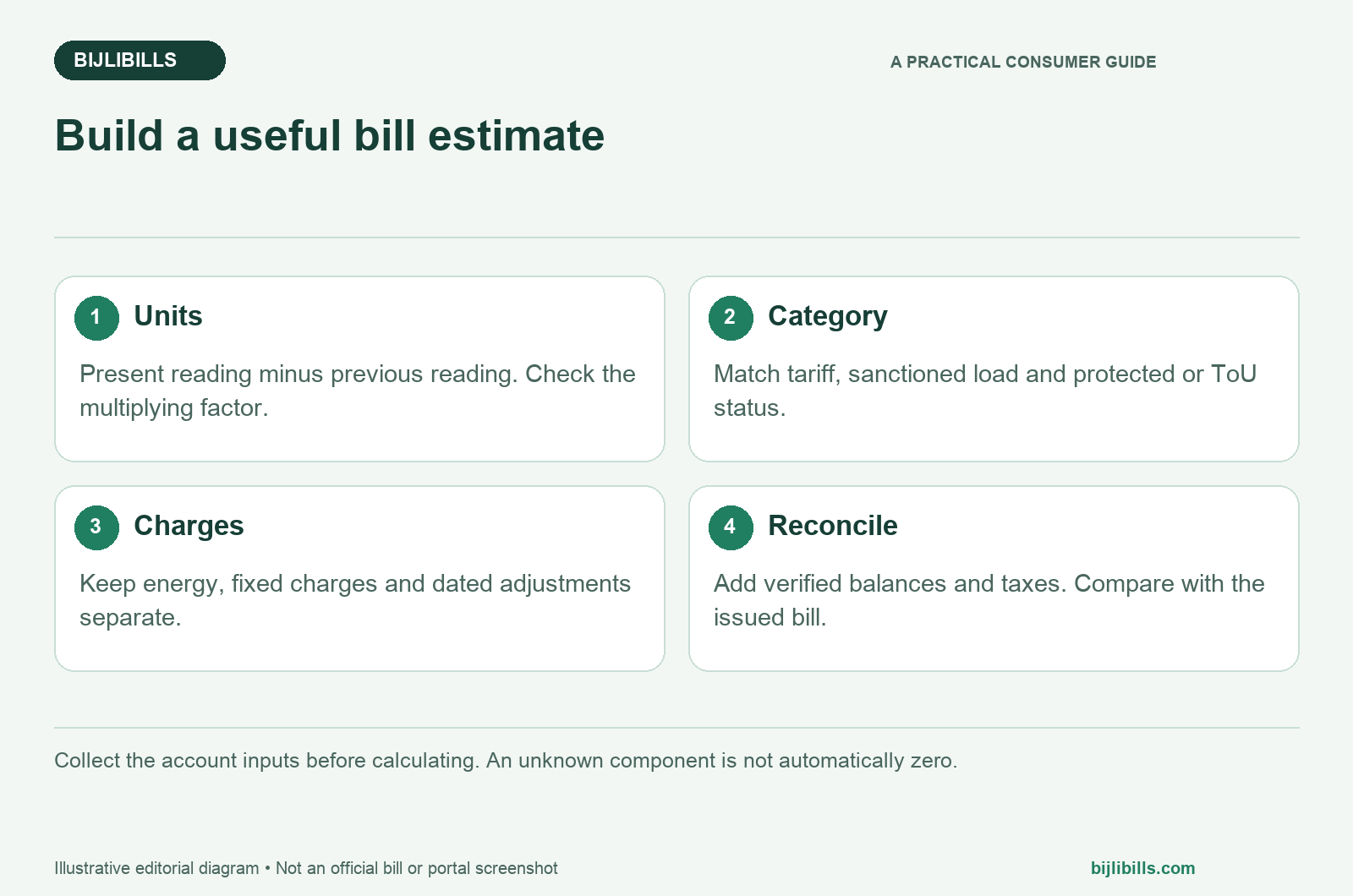
Collect the account inputs before calculating. An unknown component is not automatically zero.
FESCO bill calculator: step-by-step method
- Identify the connection. Confirm that the statement and meter belong to the same premises and account.
- Choose the task. Label your worksheet either a consumption forecast or an issued-bill check.
- Calculate units. Subtract the relevant earlier register reading from the later one. Apply a verified multiplying factor if required.
- Match the period. Record the reading dates and count the days covered. Avoid comparing a short partial month with a complete billing cycle.
- Find the correct tariff row. Match consumer category, load, status and effective date. Check whether the figure is a government-applicable charge rather than another column.
- Calculate each charge separately. Keep energy, fixed charges, adjustments and applicable taxes on distinct lines.
- Add account-specific balances. Include genuine arrears or an approved installment only when the bill or official record supports it.
- Compare like with like. Compare the estimated total with the payable-within-due-date amount, not a later amount that includes a surcharge.
- Record uncertainties. Note every unverified input before using the result to make a payment decision.
The NEPRA Consumer Service Manual, revised 26 November 2025, explains the bill's main fields in section 6.4.1. Your actual statement remains the source for account-specific balances.
Worked example: reading difference and energy cost
Suppose an illustrative single-register meter has a previous reading of 12,450 and a later reading of 12,630. Assume its verified multiplying factor is one.
12,630 − 12,450 = 180 kWh, usually called 180 units.
Now assume, only to demonstrate arithmetic, that the applicable energy charge were Rs 20 per unit across those units. The energy subtotal would be 180 × 20 = Rs 3,600. Rs 20 is a fictional teaching rate, not a quoted current FESCO tariff.
If the same example had a separately established fixed charge of Rs 400, the subtotal would become Rs 4,000 before any applicable adjustments, taxes or balances. The calculation is transparent because each assumption is visible. It would be misleading to label Rs 4,000 the official 180-unit FESCO bill.
A real slab calculation must follow the applicable tariff's slab-benefit rules. Do not automatically divide every bill into the first hundred units at one price and the next hundred at another. Read the schedule notes for the actual category.
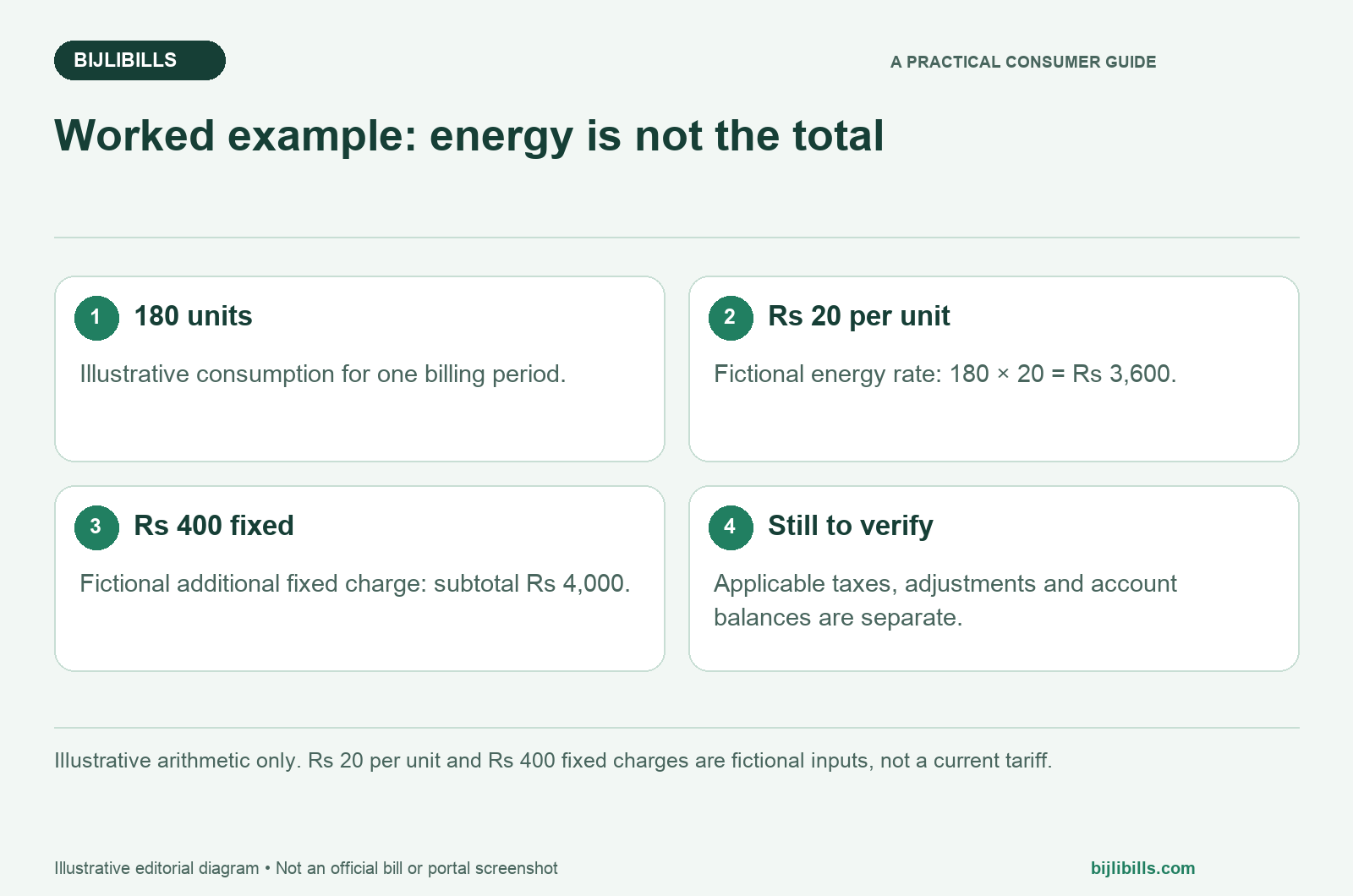
Illustrative arithmetic only. Rs 20 per unit and Rs 400 fixed charges are fictional inputs, not a current tariff.
Forecasting units before the next bill arrives
A meter log can help you anticipate consumption. Suppose you record 60 units over ten days. That is six units per day. If similar use continued for a hypothetical 30-day period, the projection would be 180 units.
This is a planning estimate, not a replacement for the official reading. Visitors, weather, appliance use and a different billing period can change the result. Keep the observation date beside the number so you can revise the forecast next week.
For an appliance, the basic arithmetic is kilowatts × hours = kilowatt-hours. A hypothetical 100-watt device operating at that draw for five hours uses 0.5 kWh. A thermostat-controlled appliance may cycle, so its label rating multiplied by every connected hour can overstate actual use.
Why a correct estimate can differ from your bill
The most useful question is which component differs. If units agree but the total does not, check fixed charges and adjustments before assuming a faulty meter. If the reading dates differ, check the period before treating a consumption change as unexplained.
A ToU account needs separate peak and off-peak calculations. A protected-status assumption needs the relevant history, not just this month's low usage. Use the protected and unprotected consumer guide to organise that check.
An adjustment may relate to an earlier consumption month. An unpaid balance can also make this month's payable amount higher without increasing this month's units. Do not remove either line just to make a calculator match an expected result.
Turn an unexplained difference into a useful inquiry
Prepare a small comparison: billed units, your correctly dated readings, applicable category, disputed charge and the reason you believe it differs. Attach relevant bills and clear meter photographs privately through the official channel.
The bill correction guide explains how to organise evidence. Ask for clarification or correction of the specific item. A calculator result by itself does not establish overbilling or change the payment deadline.
Frequently asked questions
1. Can a calculator retrieve my issued bill?
Only a tool connected to an authorised bill service can retrieve a record. An arithmetic calculator estimates charges from entered inputs.
2. Are a unit and a kilowatt the same?
No. A billed unit usually means one kilowatt-hour of energy. A kilowatt describes power, not energy consumed over time.
3. Can I estimate a FESCO bill from 300 units alone?
You can begin, but category, load, status, adjustments and account balances are still needed for a useful payable estimate.
4. Should I enter the amount after the due date?
Use the amount appropriate to your comparison. Keep late-payment charges separate when checking the normal current bill.
5. What if my multiplying factor is missing?
Confirm it with FESCO or the account record. Do not select an arbitrary factor to make the calculation fit.
6. Can last month's total predict this month's total?
It is a budgeting reference, not a tariff calculation. Units, adjustments, fixed charges and balances may differ.
7. Does zero consumption mean a zero bill?
Not necessarily. Relevant fixed or minimum charges and outstanding amounts can remain even when recorded use is zero.
8. Should I include a security deposit as energy cost?
No. Keep a deposit or connection-related amount separate from electricity consumed so the comparison remains meaningful.
9. Is a lower online estimate proof of an error?
No. First check the tool's date, tariff assumptions and omitted charges, then ask FESCO about a specific unexplained difference.
10. How should I round calculations?
The arithmetic checker above rounds each energy row to two decimal places before adding the other rupee amounts. Your supplier may use a different sequence; follow its official calculation when checking an issued bill.
11. Can I use a domestic calculator for my shop?
Only if it supports the shop's actual tariff. A residential assumption can produce the wrong result for a commercial connection.
12. Does solar generation equal exported units?
No. Some generated electricity may be used within the premises. Import/export billing needs the relevant meter records and agreement.
13. Can I compare two homes by total bill alone?
That comparison is weak without units, tariff category, sanctioned load, billing period and previous balances for both accounts.
14. Is a projected monthly reading an official pro-rata adjustment?
No. Your forecast is for planning. Official pro-rata treatment depends on the applicable rules and the account's billing circumstances.
15. Must I provide my CNIC to perform arithmetic?
No. A local estimate needs billing inputs, not identity documents. Share personal evidence only where the genuine official process requires it.
Use estimates to prepare, then verify the issued amount
Keep the calculation split into understandable parts and update it as better information becomes available. A clear estimate helps you budget and ask precise questions; the issued bill and approved corrections determine what your account shows as payable.