 Skip to content
IESCO peak hours are the higher-demand time windows used for time-of-use, or TOU, billing. The seasonal schedule below appears in IESCO’s published tariff conditions. It is not a promise that every household is charged different prices during those hours: first check whether your bill actually has peak and off-peak registers.

IESCO peak-hour schedule
| Months | Peak window in the published conditions |
|---|---|
| December to February | 5:00 pm to 9:00 pm |
| March to May | 6:00 pm to 10:00 pm |
| June to August | 7:00 pm to 11:00 pm |
| September to November | 6:00 pm to 10:00 pm |
The remaining 20 hours are off-peak under those conditions. This table comes from the NEPRA IESCO tariff determination dated 2 June 2022, not a newly issued September 2026 timing notification. Confirm any subsequent timing change with IESCO, especially if a meter clock or your billing record appears inconsistent.
Does the schedule affect your bill?
Open your IESCO duplicate bill and find the tariff category and consumption section. Separate peak and off-peak units are a useful sign that the account is being billed on a TOU basis. A neighbour having a three-phase meter is not proof that your own account has the same tariff.
Read the current IESCO tariff guide alongside your bill. Prices and applicability can change even when the time windows stay the same. The date on a price notification and the dates of the electricity consumed are different pieces of information.
What moving an appliance actually saves
Moving a flexible task to off-peak hours can reduce its energy charge if your applicable off-peak rate is lower. It does not make the units free, and it does not automatically remove fixed charges, adjustments, or taxes.
Here is an illustrative calculation, using invented rates rather than a tariff quote. Suppose a task uses 2 kWh. At Rs 45 per kWh its energy cost is Rs 90; at Rs 35 it is Rs 70. Moving that task saves Rs 20 in energy charges. To estimate your own result, use the two rates printed on your current bill.
Do not multiply the whole household bill by that percentage. Only the shifted consumption changes in this example.
Make a practical evening plan
Choose loads that are genuinely flexible: ironing, a dishwasher cycle, or pumping water into a storage tank where the installation is suitable. Do not delay necessary medical equipment, essential lighting, or food refrigeration. Follow appliance instructions and avoid leaving high-power equipment running unattended merely to meet a tariff window.
A useful household note has three entries: the task, its approximate duration, and a convenient off-peak start time. One realistic routine is easier to maintain than a long list of rules nobody follows.
When the meter and bill disagree
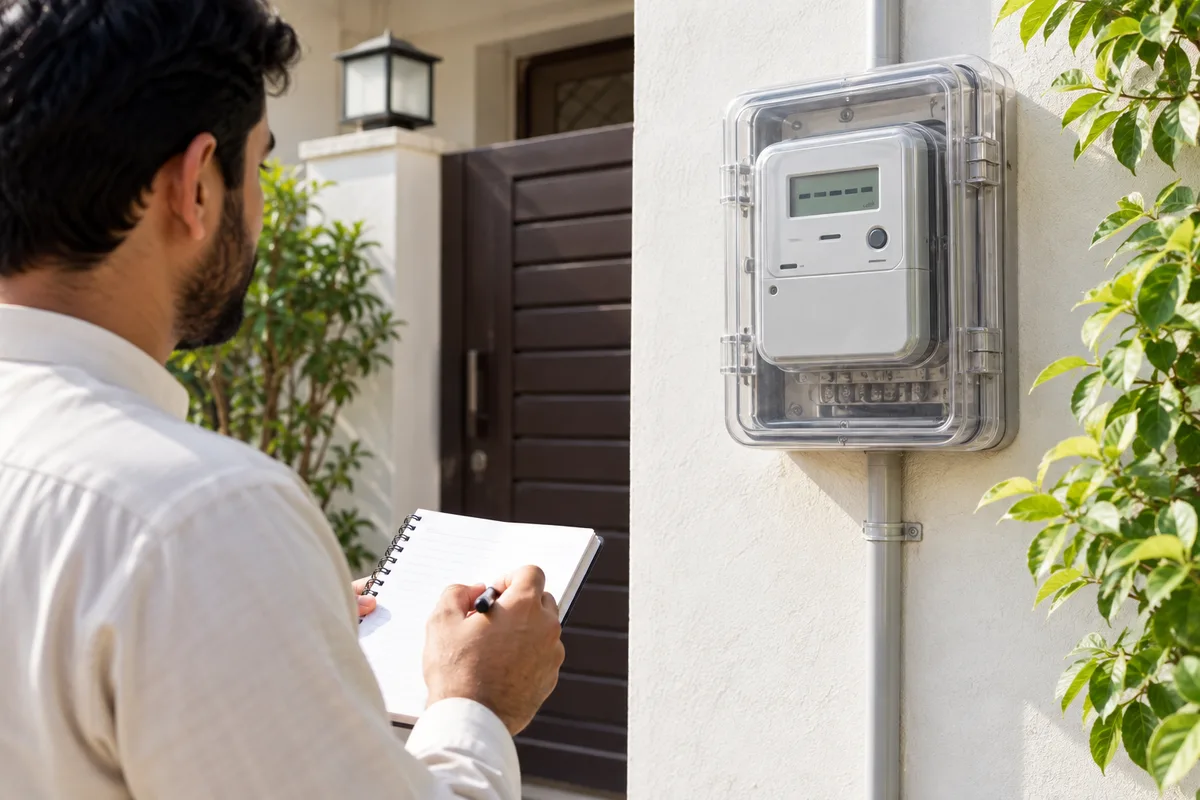
Record the bill’s reading date, the displayed register label, and the date and time of your observation. A meter may cycle through several readings; a number seen for a few seconds may not be the total imported energy. Do not open the enclosure or attempt to reset its clock.
Ask IESCO to identify the relevant registers and check the meter configuration. Our TOU bill reading guide explains how to compare two periods without adding the wrong readings together.
Sources: NEPRA’s published IESCO tariff conditions, IESCO tariff guide.
Frequently Asked Questions
What are IESCO peak hours?
They are the time windows used for peak consumption under an applicable time-of-use tariff. Whether those windows change your charges depends on your own account’s tariff.
What schedule is shown in this guide?
The table reproduces seasonal windows from the cited 2 June 2022 IESCO tariff conditions. It is not presented as a new September 2026 notification.
What is the September to November window?
The cited schedule shows 6:00 pm to 10:00 pm. Confirm any later change with IESCO before treating an older published schedule as definitive for your account.
Are peak hours the same all year?
Not in the cited seasonal schedule. It groups months into four periods, so an evening routine suitable in winter may not match the summer window.
Does every IESCO household pay peak rates?
No. First check the tariff category and whether the bill separates peak and off-peak consumption. A general schedule alone does not establish your account’s eligibility.
Where can I see whether my bill is TOU?
Look for separate peak and off-peak units and rates in the consumption section. Ask IESCO to explain the category if the labels or bill layout are unclear.
Does a three-phase meter always prove TOU billing?
Do not rely on the meter’s appearance alone. Read the actual tariff and registers used on your bill; another property’s setup may differ from yours.
What counts as off-peak time?
Under the cited four-hour peak schedule, the remaining twenty hours are off-peak. This distinction matters only when the applicable tariff uses those separate periods.
Do I need to switch off the whole house?
No. Focus on tasks that can reasonably move. Essential lighting, refrigeration, medical equipment and safety needs should not be sacrificed to follow a tariff window.
Will shifting ironing reduce the entire bill?
Only the energy charge for consumption actually moved may change. Fixed charges, arrears, taxes and adjustments do not automatically disappear when you shift one task.
How do I estimate the saving from shifting a task?
Multiply the task’s units by the difference between your applicable peak and off-peak rates. Use your current bill’s rates rather than the hypothetical figures in this guide.
Does running fewer appliances reduce total units?
It depends on their power and running time. Simply postponing the same task usually shifts its timing; using it for less time may also reduce consumption.
Should I run high-power appliances unattended at night?
No. Follow the appliance’s safety instructions and your household’s supervision needs. A possible tariff saving does not justify unsafe operation.
Why do peak units differ from my own estimate?
Your estimate may cover different dates, omit loads or use the wrong register. Compare the same billing interval and ask the supplier to explain the relevant meter labels.
Can I change the meter clock myself?
No. Do not open, reset or alter the meter. Record the displayed time and ask IESCO to check the configuration through its authorised process.
What evidence helps with a timing complaint?
Keep dated photos of the visible register and clock, the bill’s reading dates, and a short description of the mismatch. Avoid touching the enclosure or wiring.
Are peak rates fixed permanently?
No. Rates and applicability can change through tariff notifications. The timing schedule and the price charged are separate details to verify.
Does this guide quote current unit prices?
No. The arithmetic example uses clearly hypothetical rates. Your bill and the applicable tariff notification are the references for an actual cost calculation.
Can a tenant use the landlord’s peak-hour schedule?
Use the schedule and tariff for the rented connection itself. Confirm the account details rather than applying a rule from a landlord’s different property.
What is a simple first step this evening?
Identify one flexible task, check your bill’s tariff, and choose a convenient start outside the applicable peak window. Track the routine before expecting a measurable saving.
Related Guides
- Peak and Off-Peak Units: Read a TOU Electricity Bill Correctly
- Electricity Bill Fixed Charges: Sanctioned Load and MDI Explained
- K-Electric Peak Hours: Karachi TOU Timings and Bill Checks
Background reading: Electricity pricing on Wikipedia. This explains the general subject; the supplier records and source notes above govern account-specific checks.
Source review: 10 September 2026. Prepared with AI-assisted drafting and checked against the sources named in this guide. BijliBills is an independent information website. The supplier’s current bill, tariff notification, and account instructions take priority.