 Skip to content
Electricity bill terms can make a familiar monthly payment difficult to understand. The total may contain current energy charges, an earlier balance, taxes and adjustments relating to another period. Start by identifying the account and dates, then separate units from charges and previous balances. This method helps you understand a Pakistani electricity bill without assuming that every rupee is a charge for this month’s consumption.
The examples below use FESCO where a company-specific detail matters. Bill layouts and account categories vary, so compare the wording on your own document and use the relevant company’s official record for a disputed entry.
Read electricity bill terms in this order
- Confirm the connection. Check the company, account identifiers, address and meter number.
- Read the dates. Separate the billing month from the meter-reading, issue and due dates.
- Review consumption. Match previous and present readings, registers and any multiplying factor.
- Identify the tariff basis. Note the category, sanctioned load and any time-of-use fields.
- Separate the money columns. Distinguish energy charges, other current charges, adjustments and previous balances.
- Check what is payable. Read the amount within the due date and any later amount without assuming they are interchangeable.
- Keep the payment record. Save the successful provider receipt separately from the bill copy.
If you need a readable current copy, start with the BijliBills checker. The company’s bill is the source record; an independent explanation does not change the account.
Section 6.4.1 of the NEPRA Consumer Service Manual, revised 26 November 2025 describes the main bill particulars, including identification, dates, readings, history, charges and payable amounts.
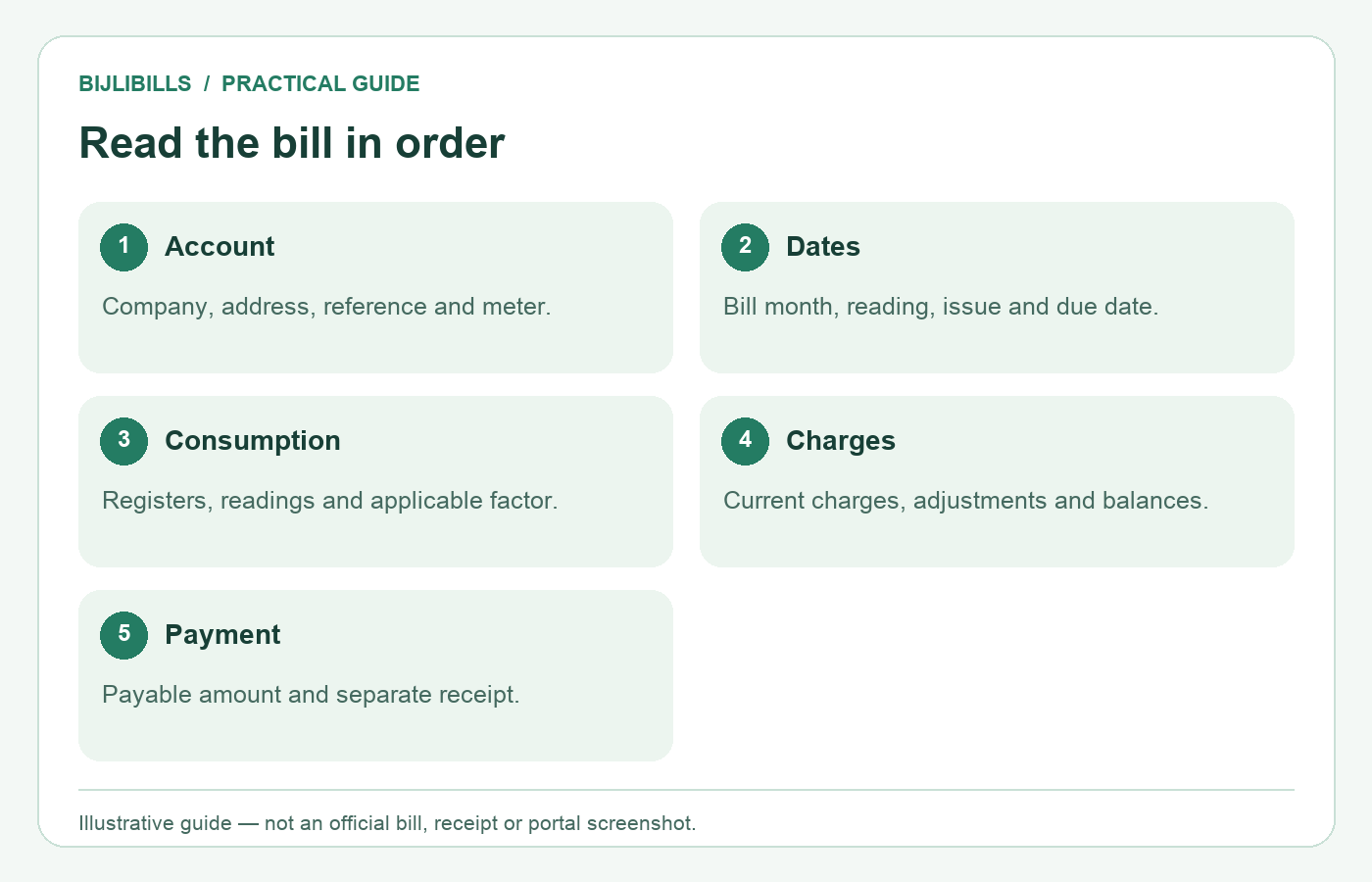
A field guide, not an authentic bill or a reproduction of FESCO’s interface.
Account details: who and what the bill identifies
The reference number identifies the billing account used by the service. The Customer ID is a separate identifier where the company provides that route. For FESCO, the inspected PITC bill portal uses a 14-digit Reference No mode and a separate 10-digit Customer ID mode. Select the matching field rather than entering either number into whichever box appears first.
The meter number identifies equipment. It is useful when confirming that the account corresponds to the physical meter, but it is not a substitute for a bill-search identifier. Our reference number versus Customer ID guide explains these distinctions across common consumer tasks.
The consumer name and service address deserve a separate check. A connection may still display a landlord or previous owner. That does not automatically prove the bill belongs to another property, but a familiar name is also insufficient verification. Compare the address and meter details together.
Bill month, reading date, issue date and due date
These fields answer different questions:
| Term | What it tells you |
|---|---|
| Bill month | The month label assigned to the bill |
| Reading date | The date associated with the recorded meter reading |
| Issue date | When the bill was issued |
| Due date | The payment deadline printed on the bill |
A bill labelled October does not mean its reading happened on the first day of October. FESCO’s October 2026 billing schedule shows different dates by batch. Use the actual account and dates instead of a neighbour’s timetable.
This distinction also matters when comparing photographs. A meter image taken several days after the reading date may show additional use. Note the dates before interpreting the difference as an error.
Units, readings and multiplying factor
A unit of electricity is commonly expressed as one kilowatt-hour, or kWh. Meter readings are cumulative records; billed units are the consumption assigned to the billing period, subject to the applicable meter and billing arrangement.
Consider an illustrative single-register example:
| Item | Hypothetical value |
|---|---|
| Previous reading | 12,450 kWh |
| Present reading | 12,690 kWh |
| Difference | 240 kWh |
| Multiplying factor assumed | 1 |
| Units from this simple calculation | 240 kWh |
The example assumes the same meter and register with multiplying factor 1. Do not copy that factor onto an account with a different metering arrangement. A meter replacement, separate registers or a billed adjustment may need additional records.
If your bill separates peak and off-peak readings, compare each current reading with its own previous reading. An import register and an export register also represent different directions of energy; they should not be casually mixed. The relevant billing treatment depends on the applicable connection and agreement.
Tariff category, sanctioned load and fixed charges
The tariff category tells you which schedule is being used for the account. Sanctioned load is an approved connection parameter, not the number of units consumed during the month. A category or load mismatch needs review of the account record, not a guess based on one appliance’s rating.
Energy or variable charges relate to billed consumption under the applicable schedule. Fixed charges follow the schedule’s stated basis. A charge expressed per consumer per month is not the same as one expressed per kW per month.
The FESCO tariff page labels its displayed schedule effective 12 February 2026. It distinguishes categories and charging bases. This guide does not reproduce a complete current tariff calculation or establish the correct category for your individual connection.
Avoid dividing the entire bill by units and calling that result the official energy rate. The resulting average can include taxes, balances and adjustments. It may help household budgeting, but it answers a different question from the published tariff.
Adjustments, taxes and previous balances
Fuel Price Adjustment, often abbreviated FPA, is separate from the basic energy charge. Its relevant consumption month can differ from the month in which it appears on the bill. The FESCO FPA archive separates these periods. Our FPA explanation shows how to read the period and sign of an adjustment without assuming a timeless rate.
Quarterly Tariff Adjustment, or QTA, is another separately notified component. Do not merge its rate with FPA or treat either as the entire electricity price. Applicability, periods and exceptions come from the relevant notification.
Tax labels also need care. The name of a tax is not enough to determine its rate, base or exemption for a particular account. This guide does not certify a current tax table; use the applicable authority’s instructions and the company’s calculation where clarification is needed.
Arrears refer to an unpaid earlier bill amount recorded on the account. Deferred amounts and approved installments are separate fields or arrangements. If you believe an earlier amount was already paid, compare the month and reference with the original receipt rather than assuming every carried-forward balance is correct or incorrect.
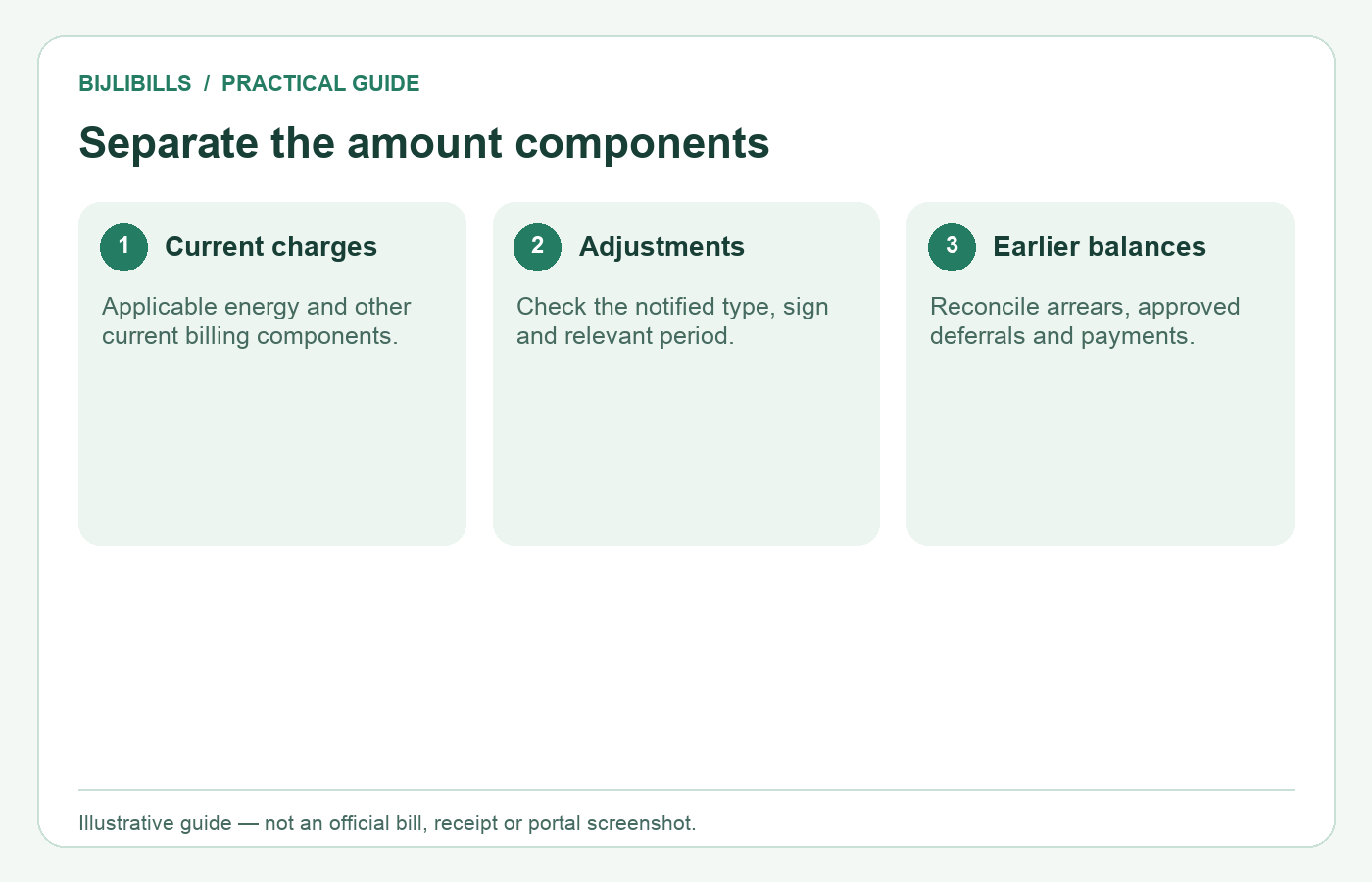
The boxes explain categories only. They do not provide tariff rates or an individual payable estimate.
Payable amounts, history and receipts
Check the amount payable within the due date and the later amount shown on your bill. Do not manually alter a PDF to create an extension or split payment. Approved extensions and installments require the official process; section 6.8 of the revised manual provides for computerized revised bills.
The manual also describes 12 months of billing and payment history on the bill. A summary of past units and payments is not the same as a portal offering 12 downloadable full bill PDFs. Save your own monthly copies and receipts for clearer comparisons.
If a field remains unexplained, write down its label, amount and period and ask the company to identify the basis. For a demonstrable reading or account error, our electricity bill correction guide explains how to prepare evidence.
Frequently asked questions
Is a unit the same as one hour of electricity?
No. Consumption depends on power and time. Appliances with different power draw can use different amounts over the same hour.
Does the consumer name prove legal property ownership?
Do not use a bill as a substitute for the relevant ownership record. Ask the appropriate authority about documents required for a specific purpose.
Why is my meter number different from the reference number?
They identify different things: equipment and a billing account. The bill can legitimately display both.
Should every bill show peak and off-peak columns?
No. Read the fields applicable to your tariff and metering arrangement. Do not assume every domestic connection uses time-of-use billing.
Can a negative adjustment reduce the payable total?
Its sign matters, but examine the applicable period and the rest of the bill. One credit does not establish the account’s final balance by itself.
Is an adjustment always caused by a meter mistake?
No. A notified price adjustment and a correction to a reading are different matters. Ask which kind of entry is shown.
Can I compare this month directly with a shorter reading period?
Compare both days and units before drawing a conclusion. Different periods can make a simple total-to-total comparison misleading.
Does sanctioned load tell me my exact daily use?
No. It is a connection parameter. Actual consumption depends on equipment use and is recorded through the metering arrangement.
Why might fixed charges remain when units are low?
Check the applicable tariff basis. A fixed component is not necessarily calculated from the month’s kWh alone.
Does the issue date replace the due date?
No. Use each field for its stated purpose. The payment deadline is the due date printed on the bill or an officially approved revision.
Can a history row replace my lost payment receipt?
It may help reconcile the account, but keep the provider’s actual payment evidence where available, especially for a disputed transaction.
What if the previous reading differs after meter replacement?
Request the old and new meter records and the billing explanation. A single uninterrupted subtraction may no longer describe the period correctly.
Is a paid stamp the same as a downloaded duplicate?
No. A duplicate gives billing information. Payment evidence records a transaction or acknowledged payment.
Can I infer my protected status from this month’s units alone?
Do not assume that one figure settles the category. Check the applicable definition and the status recorded for your account.
Which fields should I hide before sharing a bill publicly?
Avoid exposing names, addresses, full account identifiers and payment codes. For general explanations, a redacted example is usually enough.
Read the bill as a set of records
Identify the account, align the dates, check consumption, and then separate charges from older balances. That order gives you a clearer payment decision and a more precise question whenever a field on your electricity bill needs explanation.
Pingback: MEPCO Bill Check Without Reference Number 2026: 7 Real Methods
Pingback: LESCO Bill Check Without Reference Number 2026: 7 Working Ways